
DP-FedPGN: Finding Global Flat Minima for Differentially Private Federated Learning via Penalizing Gradient Norm
- FedML
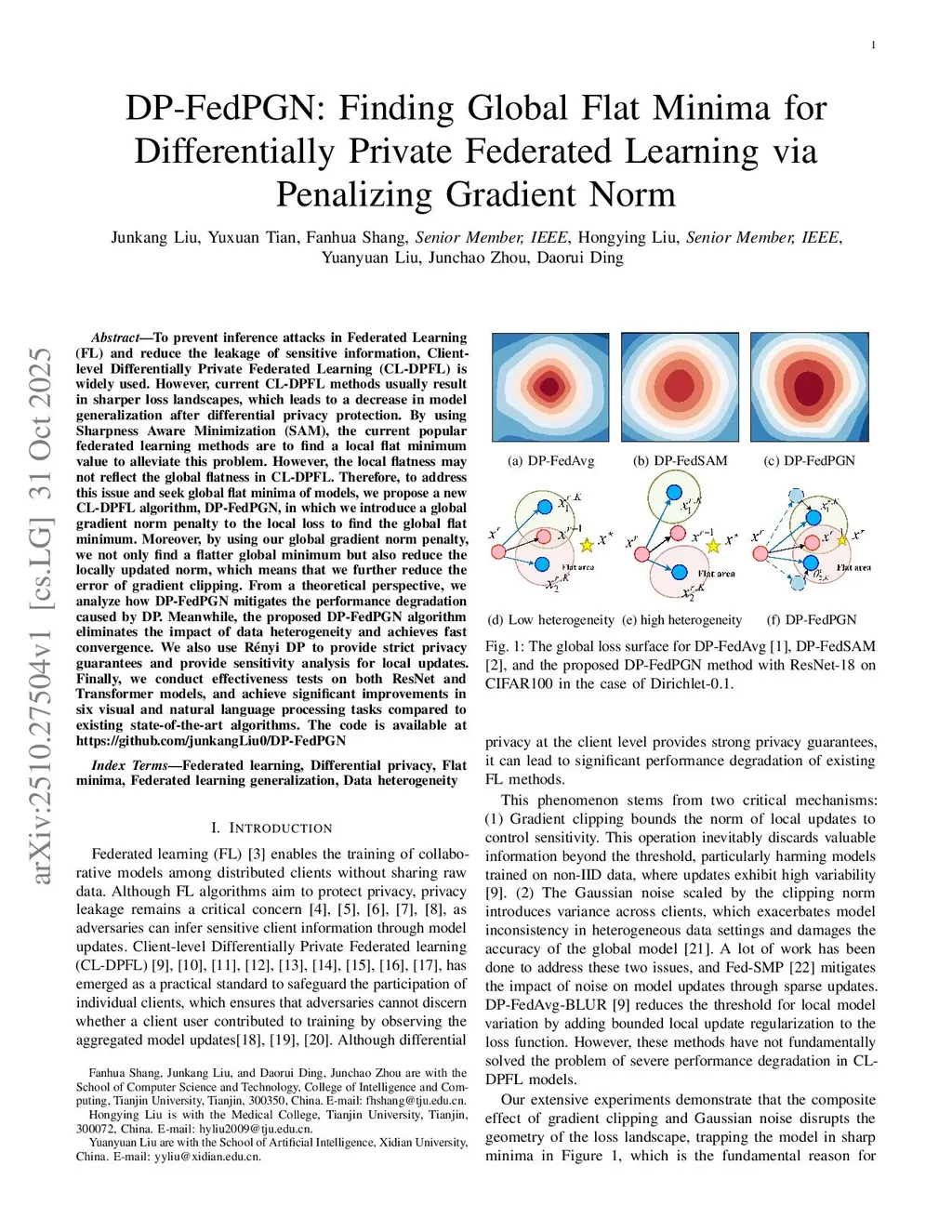
To prevent inference attacks in Federated Learning (FL) and reduce the leakage of sensitive information, Client-level Differentially Private Federated Learning (CL-DPFL) is widely used. However, current CL-DPFL methods usually result in sharper loss landscapes, which leads to a decrease in model generalization after differential privacy protection. By using Sharpness Aware Minimization (SAM), the current popular federated learning methods are to find a local flat minimum value to alleviate this problem. However, the local flatness may not reflect the global flatness in CL-DPFL. Therefore, to address this issue and seek global flat minima of models, we propose a new CL-DPFL algorithm, DP-FedPGN, in which we introduce a global gradient norm penalty to the local loss to find the global flat minimum. Moreover, by using our global gradient norm penalty, we not only find a flatter global minimum but also reduce the locally updated norm, which means that we further reduce the error of gradient clipping. From a theoretical perspective, we analyze how DP-FedPGN mitigates the performance degradation caused by DP. Meanwhile, the proposed DP-FedPGN algorithm eliminates the impact of data heterogeneity and achieves fast convergence. We also use Rényi DP to provide strict privacy guarantees and provide sensitivity analysis for local updates. Finally, we conduct effectiveness tests on both ResNet and Transformer models, and achieve significant improvements in six visual and natural language processing tasks compared to existing state-of-the-art algorithms. The code is available atthis https URL
View on arXiv