
The Algorithmic Phase Transition in Correlated Spiked Models
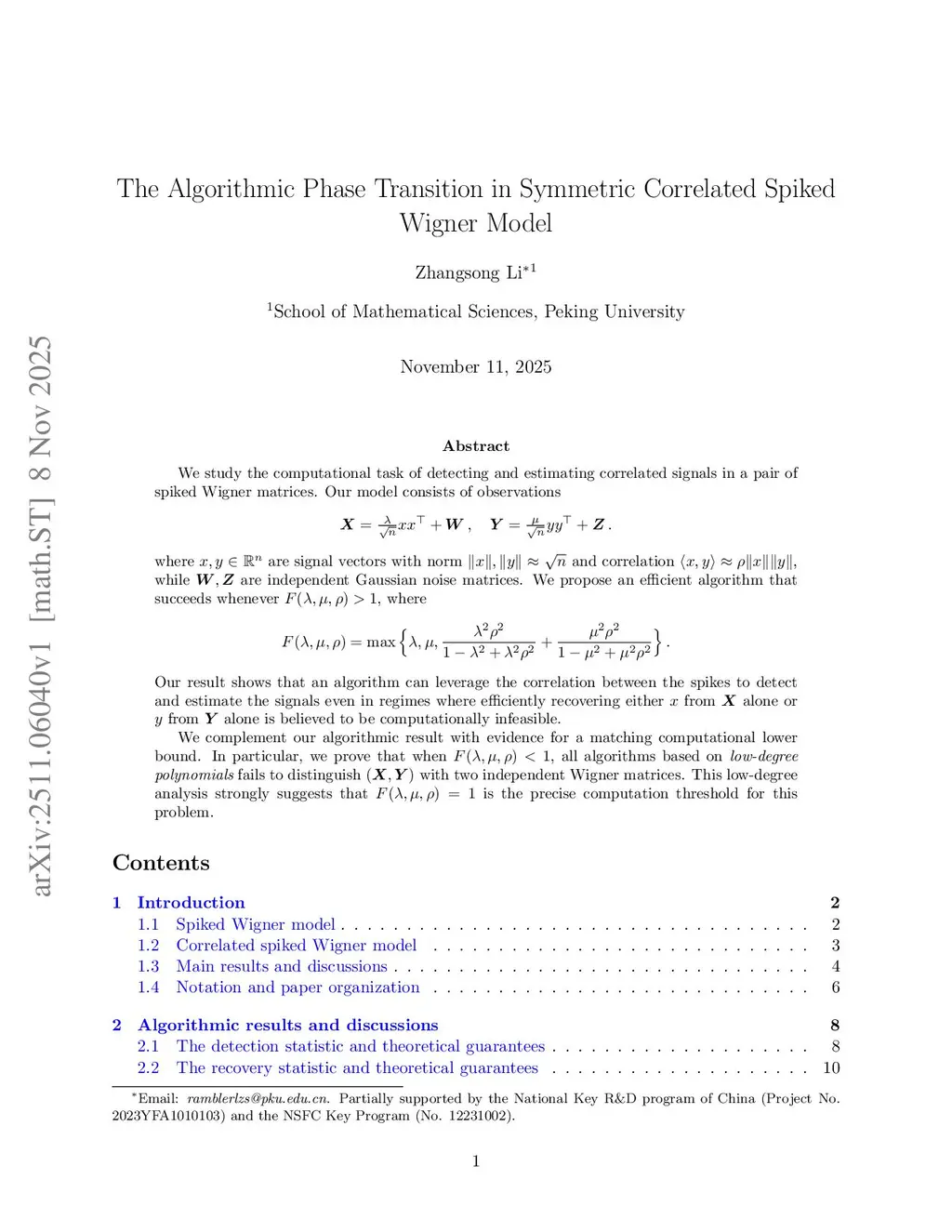
We study the computational task of detecting and estimating correlated signals in a pair of spiked matrices where the spikes have correlation . Specifically, we consider two fundamental models: (1) Correlated spiked Wigner model with signal-to-noise ratio ; (2) Correlated spiked Wishart (covariance) model with signal-to-noise ratio .We propose an efficient detection and estimation algorithm based on counting a specific family of edge-decorated cycles. The algorithm's performance is governed by the function We prove our algorithm succeeds for the correlated spiked Wigner model whenever , and succeeds for the correlated spiked Wishart model whenever . Our result shows that an algorithm can leverage the correlation between the spikes to detect and estimate the signals even in regimes where efficiently recovering either from alone or from alone is believed to be computationally infeasible.We complement our algorithmic results with evidence for a matching computational lower bound. In particular, we prove that when for the correlated spiked Wigner model and when for the spiked Wishart model, all algorithms based on low-degree polynomials fails to distinguish with two independent noise matrices. This strongly suggests that is the precise computation threshold for our models.
View on arXiv