
UniADC: A Unified Framework for Anomaly Detection and Classification
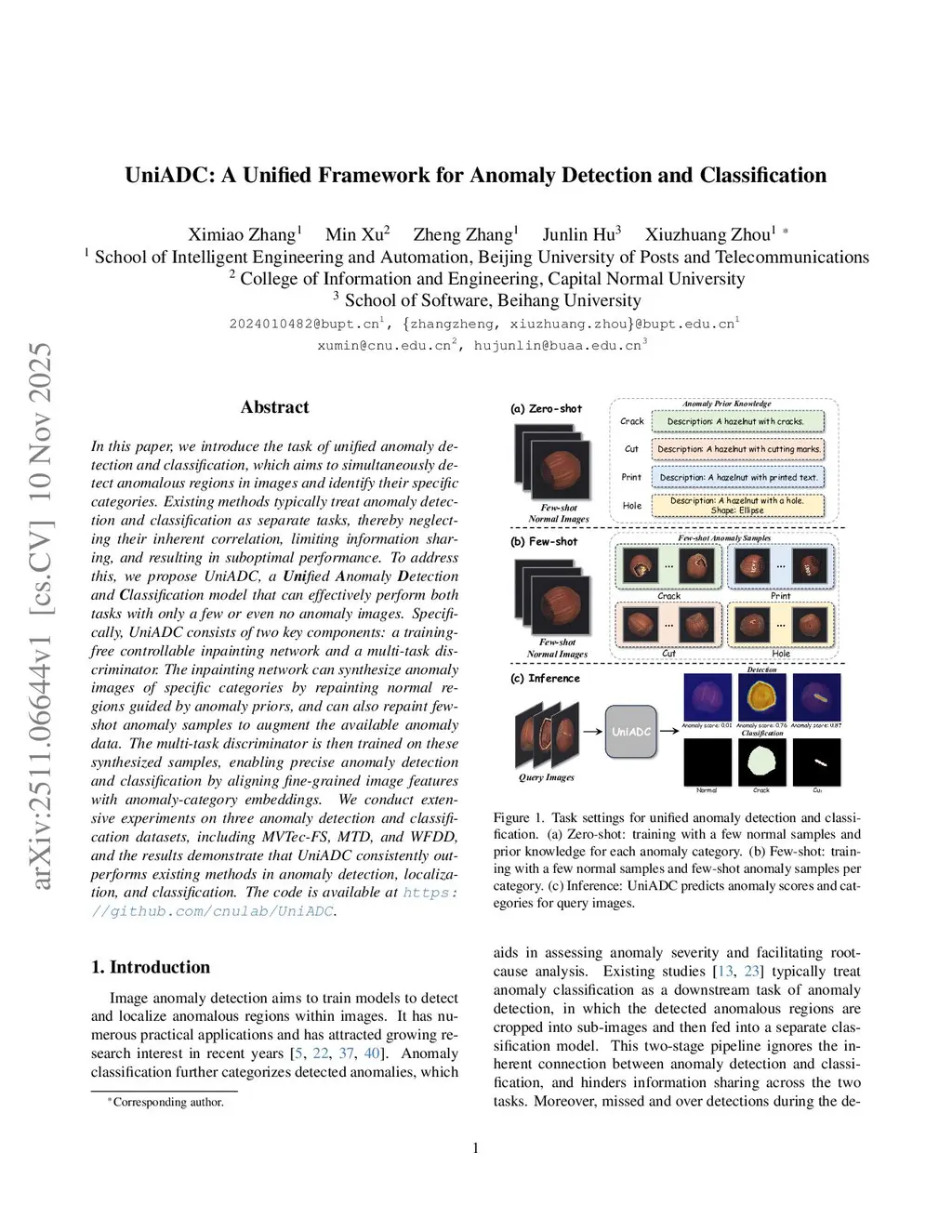
In this paper, we introduce a novel task termed unified anomaly detection and classification, which aims to simultaneously detect anomalous regions in images and identify their specific categories. Existing methods typically treat anomaly detection and classification as separate tasks, thereby neglecting their inherent correlations and limiting information sharing, which results in suboptimal performance. To address this, we propose UniADC, a model designed to effectively perform both tasks with only a few or even no anomaly images. Specifically, UniADC consists of two key components: a training-free Controllable Inpainting Network and an Implicit-Normal Discriminator. The inpainting network can synthesize anomaly images of specific categories by repainting normal regions guided by anomaly priors, and can also repaint few-shot anomaly samples to augment the available anomaly data. The implicit-normal discriminator addresses the severe challenge of the imbalance between normal and anomalous pixel distributions by implicitly modeling the normal state, achieving precise anomaly detection and classification by aligning fine-grained image features with anomaly-category embeddings. We conduct extensive experiments on three anomaly detection and classification datasets, including MVTec-FS, MTD, and WFDD, and the results demonstrate that UniADC consistently outperforms existing methods in anomaly detection, localization, and classification. The code is available atthis https URL.
View on arXiv