
CAST-LUT: Tokenizer-Guided HSV Look-Up Tables for Purple Flare Removal
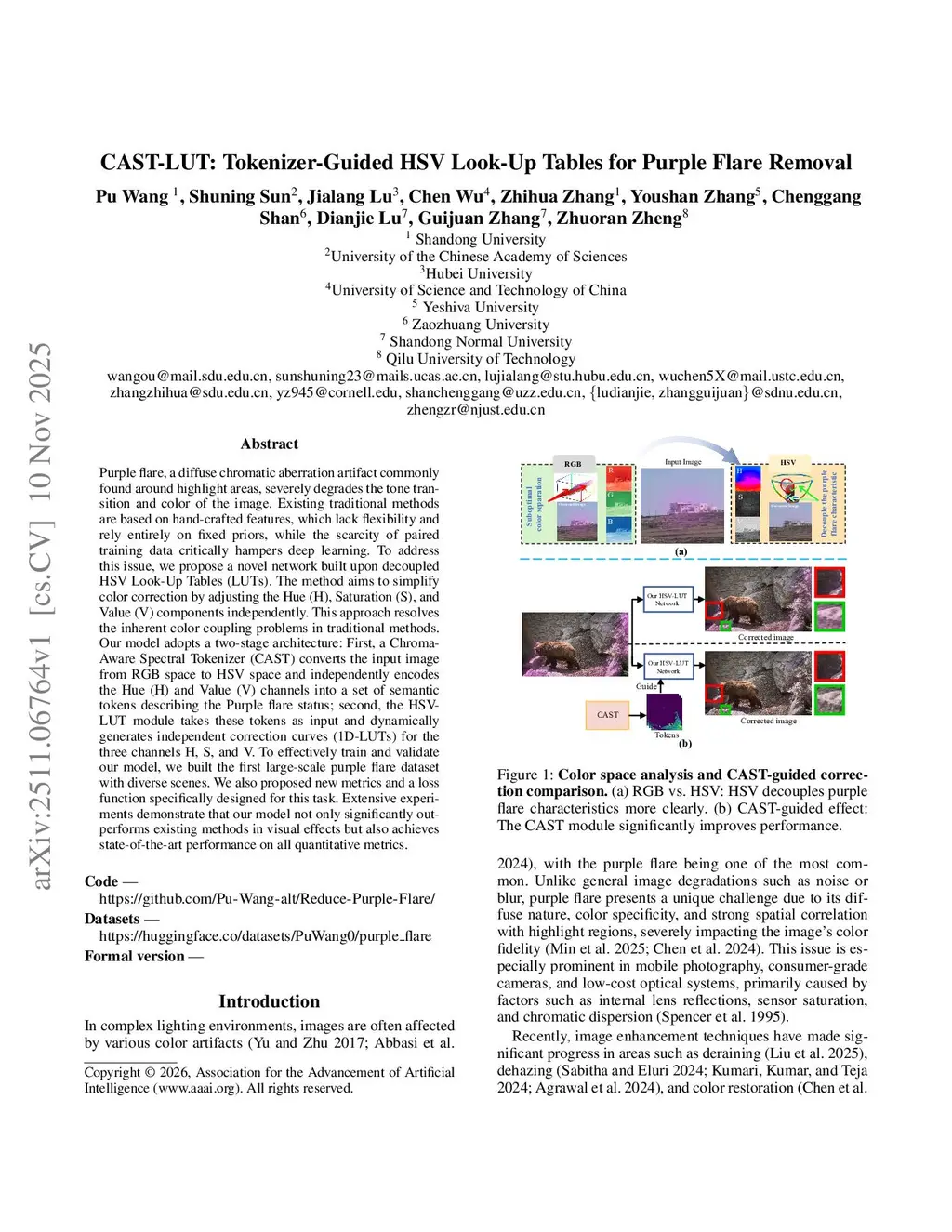
Purple flare, a diffuse chromatic aberration artifact commonly found around highlight areas, severely degrades the tone transition and color of the image. Existing traditional methods are based on hand-crafted features, which lack flexibility and rely entirely on fixed priors, while the scarcity of paired training data critically hampers deep learning. To address this issue, we propose a novel network built upon decoupled HSV Look-Up Tables (LUTs). The method aims to simplify color correction by adjusting the Hue (H), Saturation (S), and Value (V) components independently. This approach resolves the inherent color coupling problems in traditional methods. Our model adopts a two-stage architecture: First, a Chroma-Aware Spectral Tokenizer (CAST) converts the input image from RGB space to HSV space and independently encodes the Hue (H) and Value (V) channels into a set of semantic tokens describing the Purple flare status; second, the HSV-LUT module takes these tokens as input and dynamically generates independent correction curves (1D-LUTs) for the three channels H, S, and V. To effectively train and validate our model, we built the first large-scale purple flare dataset with diverse scenes. We also proposed new metrics and a loss function specifically designed for this task. Extensive experiments demonstrate that our model not only significantly outperforms existing methods in visual effects but also achieves state-of-the-art performance on all quantitative metrics.
View on arXiv