
Boosting Fine-Grained Urban Flow Inference via Lightweight Architecture and Focalized Optimization
- AI4CE
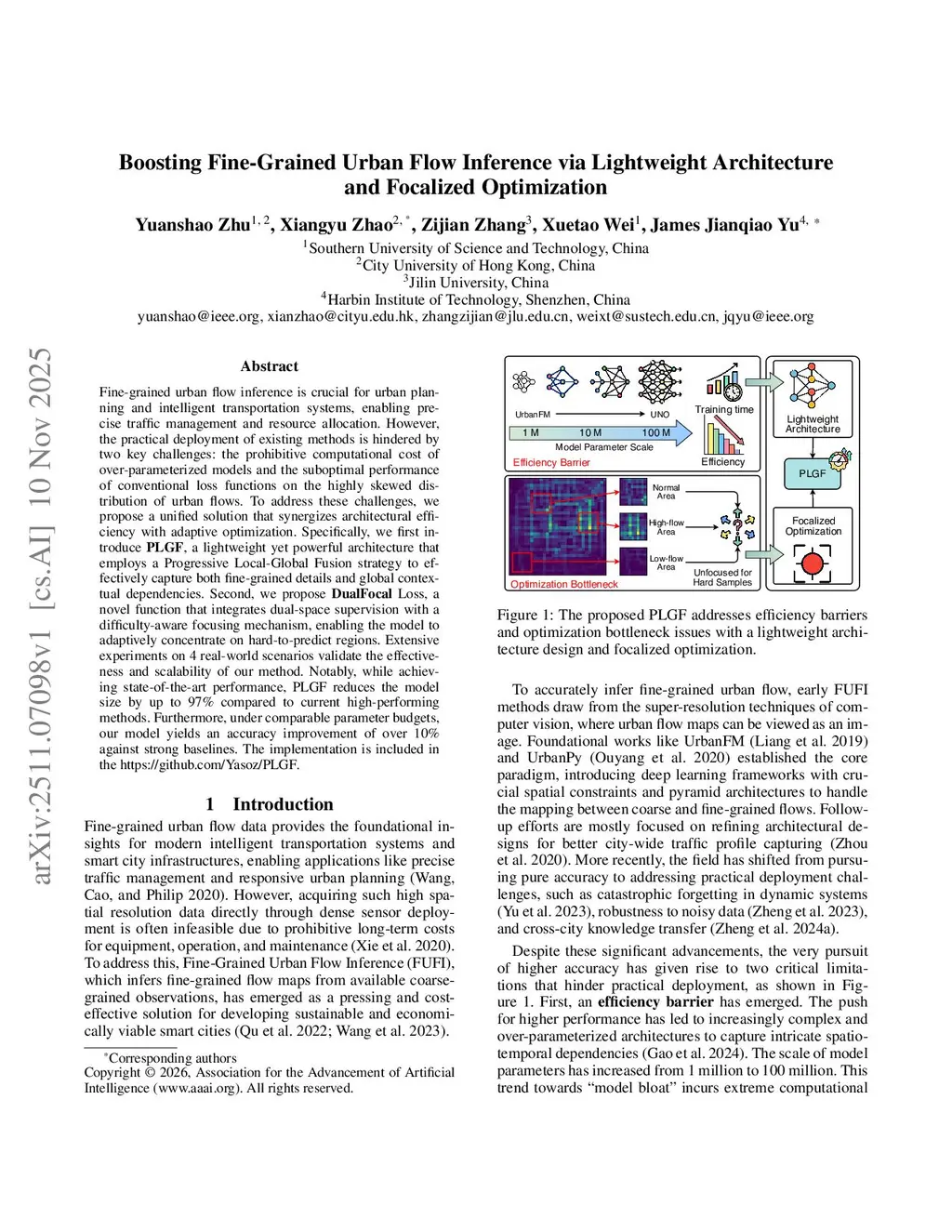
Fine-grained urban flow inference is crucial for urban planning and intelligent transportation systems, enabling precise traffic management and resource allocation. However, the practical deployment of existing methods is hindered by two key challenges: the prohibitive computational cost of over-parameterized models and the suboptimal performance of conventional loss functions on the highly skewed distribution of urban flows. To address these challenges, we propose a unified solution that synergizes architectural efficiency with adaptive optimization. Specifically, we first introduce PLGF, a lightweight yet powerful architecture that employs a Progressive Local-Global Fusion strategy to effectively capture both fine-grained details and global contextual dependencies. Second, we propose DualFocal Loss, a novel function that integrates dual-space supervision with a difficulty-aware focusing mechanism, enabling the model to adaptively concentrate on hard-to-predict regions. Extensive experiments on 4 real-world scenarios validate the effectiveness and scalability of our method. Notably, while achieving state-of-the-art performance, PLGF reduces the model size by up to 97% compared to current high-performing methods. Furthermore, under comparable parameter budgets, our model yields an accuracy improvement of over 10% against strong baselines. The implementation is included in thethis https URL.
View on arXiv