
Fine-Grained Representation for Lane Topology Reasoning
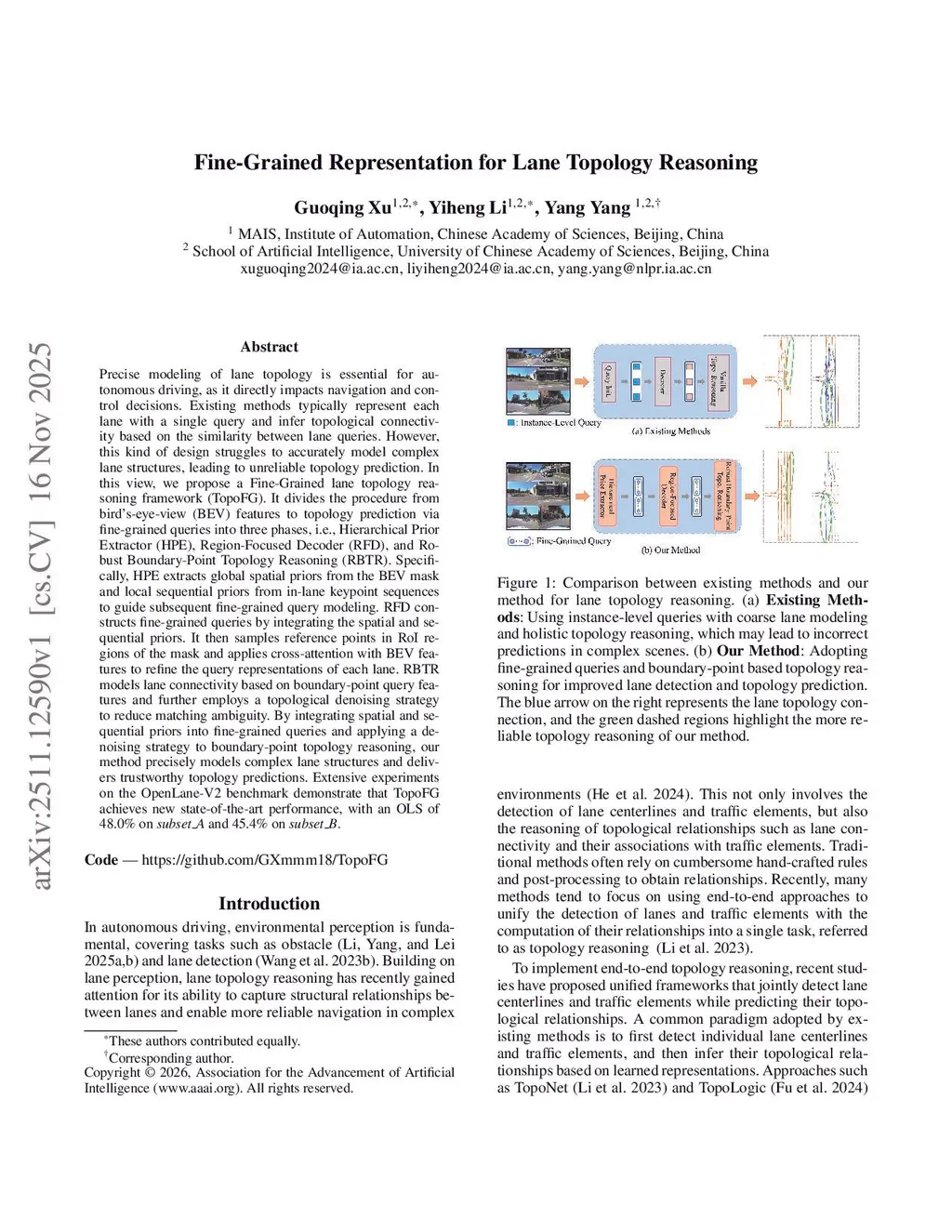
Precise modeling of lane topology is essential for autonomous driving, as it directly impacts navigation and control this http URL methods typically represent each lane with a single query and infer topological connectivity based on the similarity between lane this http URL, this kind of design struggles to accurately model complex lane structures, leading to unreliable topology this http URL this view, we propose a Fine-Grained lane topology reasoning framework (TopoFG).It divides the procedure from bird's-eye-view (BEV) features to topology prediction via fine-grained queries into three phases, i.e., Hierarchical Prior Extractor (HPE), Region-Focused Decoder (RFD), and Robust Boundary-Point Topology Reasoning (RBTR).Specifically, HPE extracts global spatial priors from the BEV mask and local sequential priors from in-lane keypoint sequences to guide subsequent fine-grained query this http URL constructs fine-grained queries by integrating the spatial and sequential priors. It then samples reference points in RoI regions of the mask and applies cross-attention with BEV features to refine the query representations of each this http URL models lane connectivity based on boundary-point query features and further employs a topological denoising strategy to reduce matching this http URL integrating spatial and sequential priors into fine-grained queries and applying a denoising strategy to boundary-point topology reasoning, our method precisely models complex lane structures and delivers trustworthy topology this http URL experiments on the OpenLane-V2 benchmark demonstrate that TopoFG achieves new state-of-the-art performance, with an OLS of 48.0% on subsetA and 45.4% on subsetB.
View on arXiv