
ReflexGrad: A Dual-Process Architecture for Gradient-Free Inference-Time Learning
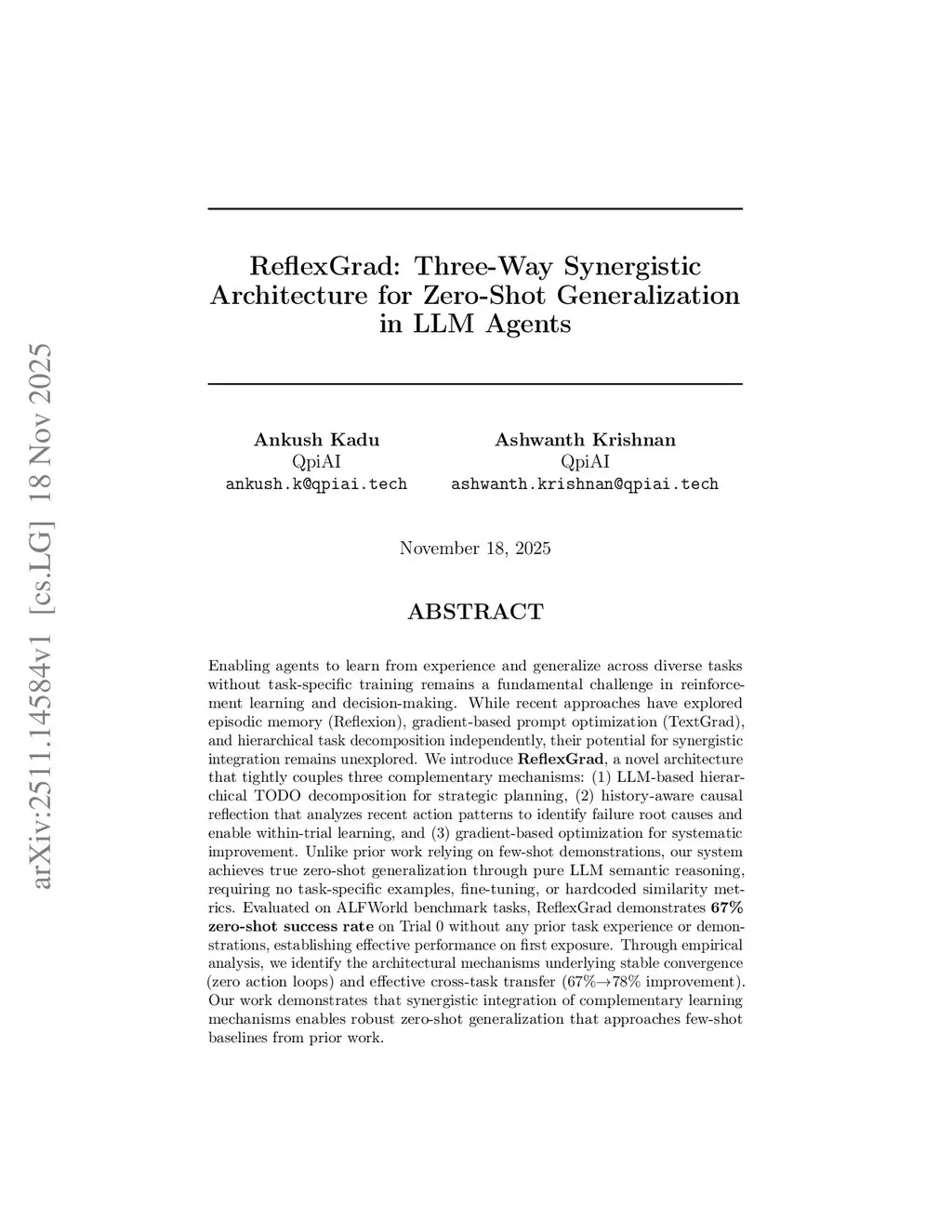
Scaling inference-time compute has emerged as a powerful paradigm--yet deliberating longer is not the same as learning. Current approaches to extended reasoning in large language models allocate more computation to thinking but remain fundamentally static: they cannot adapt from mistakes encountered during execution. Online reinforcement learning offers adaptation but requires gradient updates at runtime--expensive, prone to catastrophic forgetting, and unstable in deployment. We introduce ReflexGrad, a gradient-free framework for genuine inference-time learning: adaptation without retraining, without weight updates, without demonstrations. Our key insight is that effective runtime learning requires two complementary mechanisms--rapid policy refinement during forward progress, and deliberate causal diagnosis when stuck--with intelligent routing between them. ReflexGrad implements this by optimizing a natural language "policy" through textual feedback while keeping model weights frozen. When failures occur, the system analyzes recent action-outcome sequences to identify root causes and immediately applies corrections within the same execution--eliminating the need for multiple trials. Evaluated zero-shot across diverse interactive tasks without task-specific engineering, ReflexGrad achieves strong single-execution performance, demonstrating that gradient-free inference-time learning is not just theoretically appealing but practically viable.
View on arXiv