
The Role of Consequential and Functional Sound in Human-Robot Interaction: Toward Audio Augmented Reality Interfaces
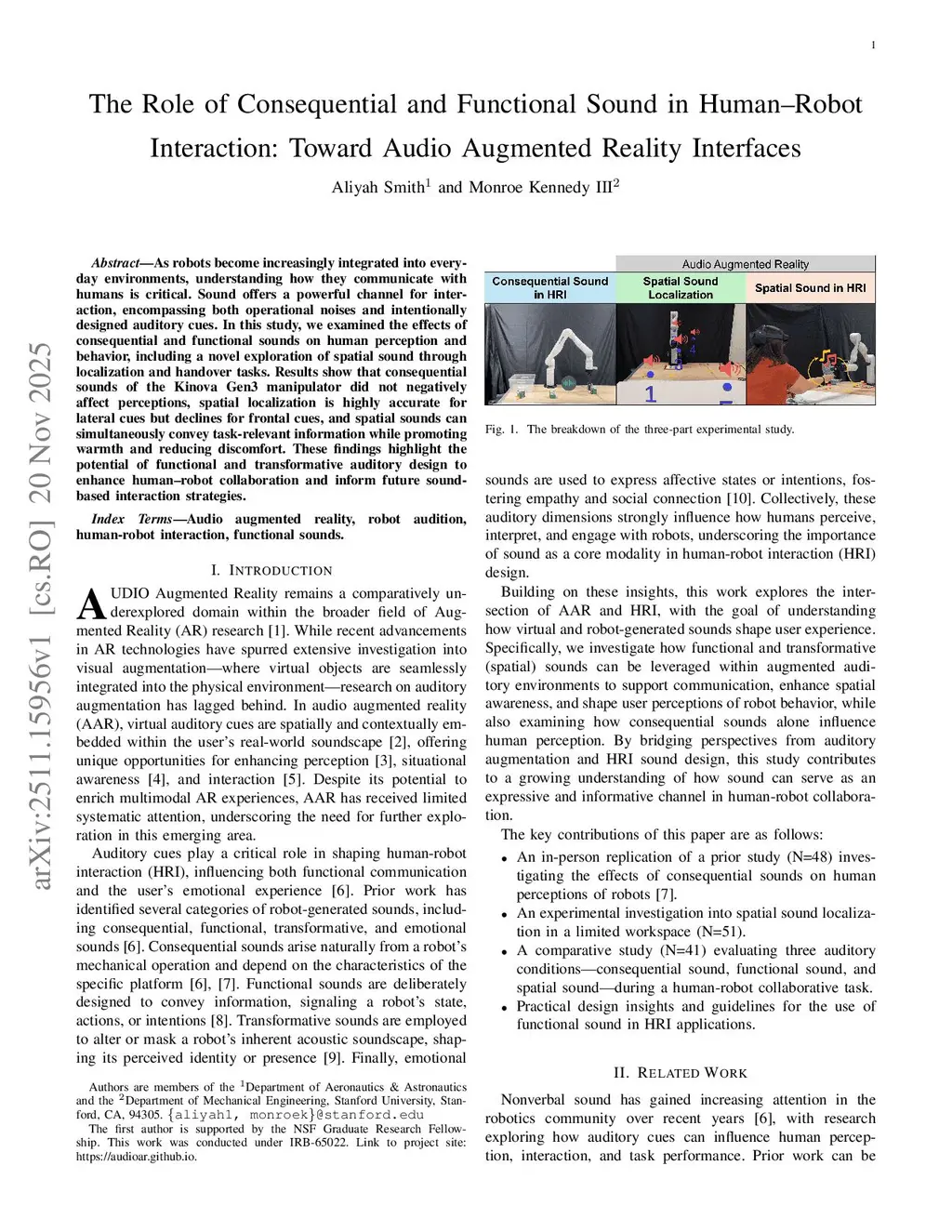
Robot sound, encompassing both consequential operational noise and intentionally designed auditory cues, plays an important role in human-robot interaction (HRI). Developing a deeper understanding of how robot sounds influence human experience, and how technologies such as augmented reality (AR) modulate these effects, can enable the design of more socially acceptable robots and more effective, intuitive human-robot interfaces. In this work, we present a three-part mixed-methods study (N = 51) that investigates (i) the effects of consequential robot sounds on human perception under varying degrees of physical colocation, (ii) human accuracy in localizing spatial audio cues delivered via augmented reality, and (iii) the use of augmented spatial audio cues for functional and transformative communication during collaborative handover tasks, in comparison to non-AR sound designs. Contrary to prior findings, our results indicate that the consequential sounds of a Kinova Gen3 manipulator did not negatively affect participants' perceptions of the robot. Participants demonstrated high accuracy in localizing lateral spatial cues, whereas frontal cues proved more challenging, delineating conditions under which spatial auditory feedback is most effective. Qualitative findings further reveal that augmented spatial audio cues can simultaneously convey task-relevant information while fostering a sense of warmth and reducing user discomfort during interaction. Together, these findings elucidate the perceptual effects of consequential robot sound and position sound, particularly augmented spatial audio, as a meaningful yet underutilized design resource for human-robot interaction.
View on arXiv