
How Robot Dogs See the Unseeable: Improving Visual Interpretability via Peering for Exploratory Robots
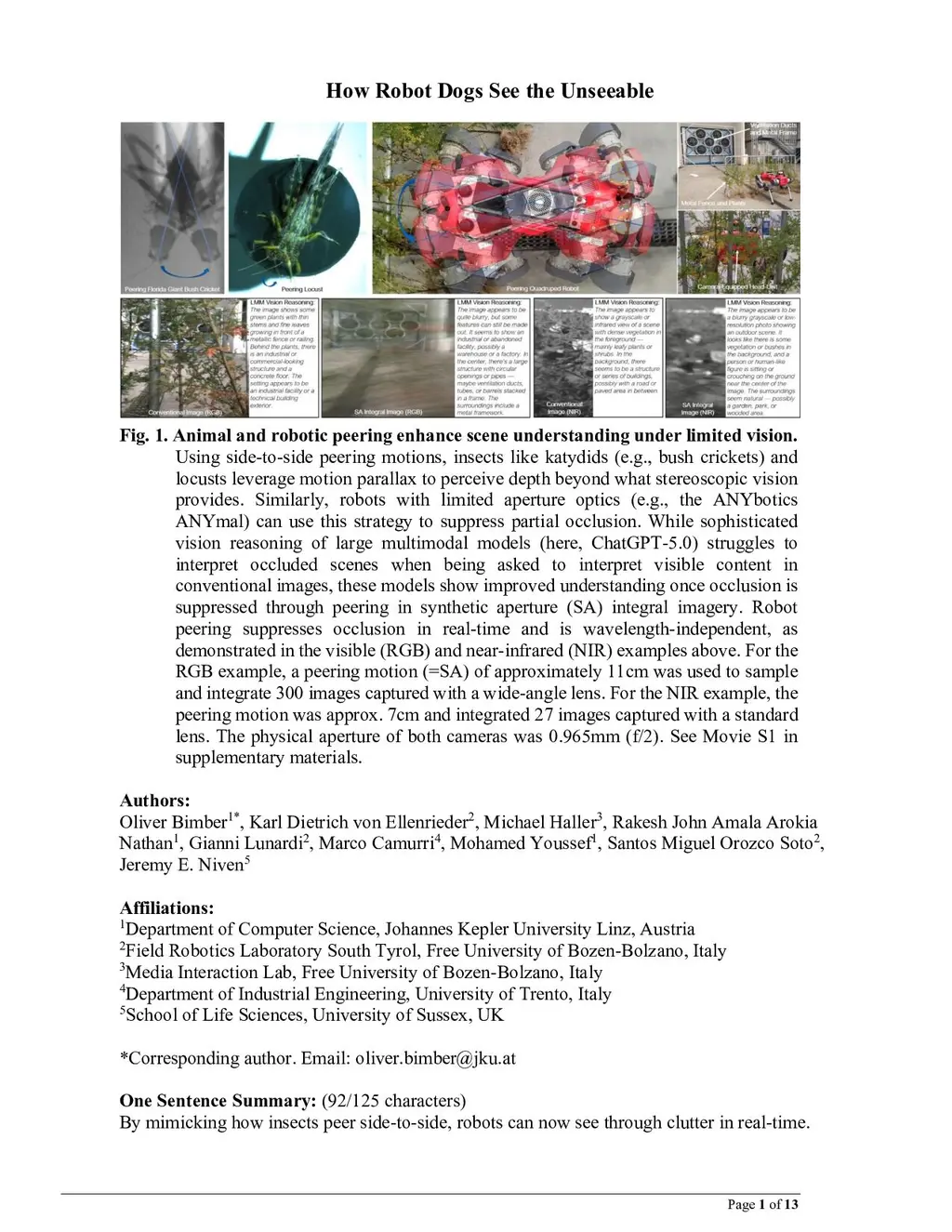
In vegetated environments, such as forests, exploratory robots play a vital role in navigating complex, cluttered environments where human access is limited and traditional equipment struggles. Visual occlusion from obstacles, such as foliage, can severely obstruct a robot's sensors, impairing scene understanding. We show that "peering", a characteristic side-to-side movement used by insects to overcome their visual limitations, can also allow robots to markedly improve visual reasoning under partial occlusion. This is accomplished by applying core signal processing principles, specifically optical synthetic aperture sensing, together with the vision reasoning capabilities of modern large multimodal models. Peering enables real-time, high-resolution, and wavelength-independent perception, which is crucial for vision-based scene understanding across a wide range of applications. The approach is low-cost and immediately deployable on any camera-equipped robot. We investigated different peering motions and occlusion masking strategies, demonstrating that, unlike peering, state-of-the-art multi-view 3D vision techniques fail in these conditions due to their high susceptibility to occlusion. Our experiments were carried out on an industrial-grade quadrupedal robot. However, the ability to peer is not limited to such platforms, but potentially also applicable to bipedal, hexapod, wheeled, or crawling platforms. Robots that can effectively see through partial occlusion will gain superior perception abilities - including enhanced scene understanding, situational awareness, camouflage breaking, and advanced navigation in complex environments.
View on arXiv