
GCL-OT: Graph Contrastive Learning with Optimal Transport for Heterophilic Text-Attributed Graphs
- OT
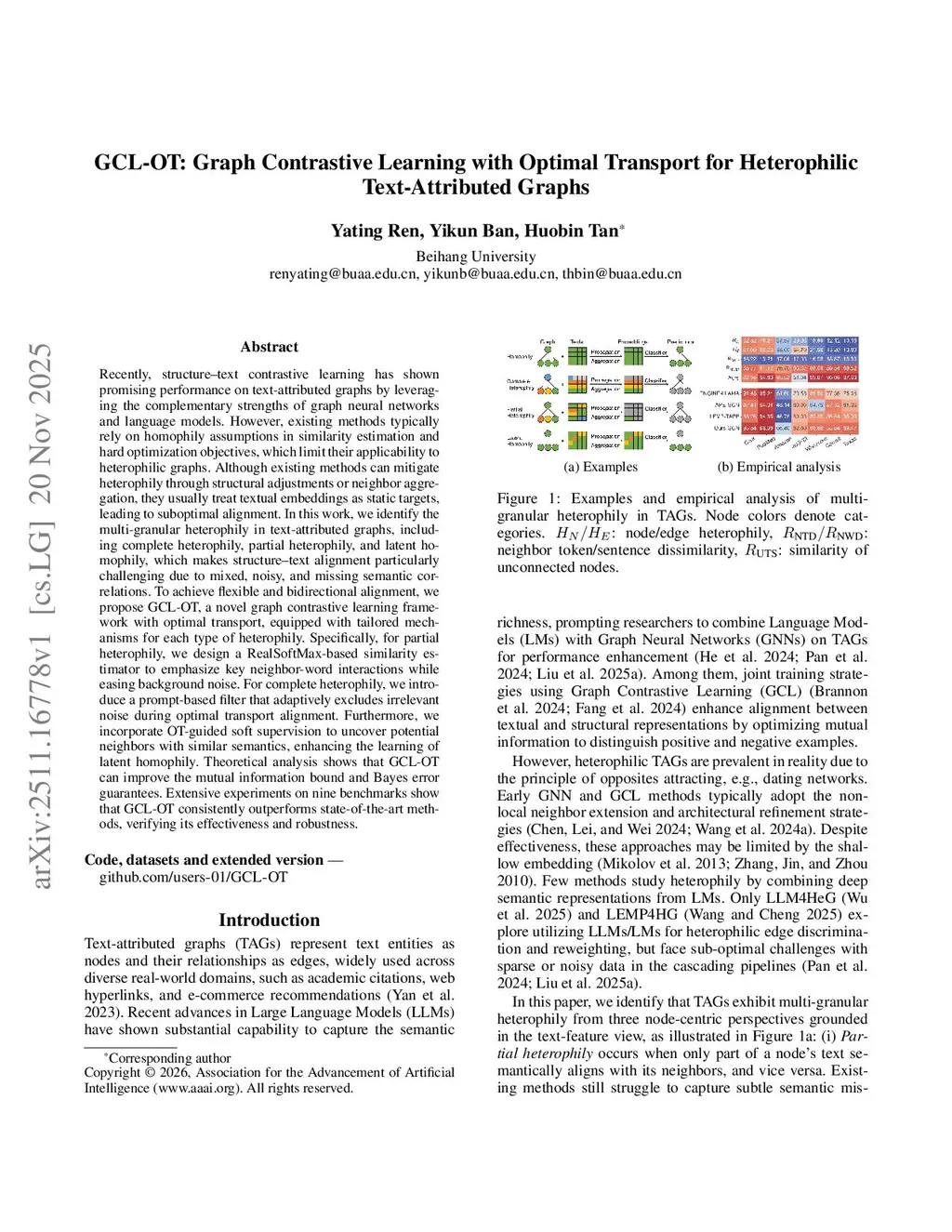
Recently, structure-text contrastive learning has shown promising performance on text-attributed graphs by leveraging the complementary strengths of graph neural networks and language models. However, existing methods typically rely on homophily assumptions in similarity estimation and hard optimization objectives, which limit their applicability to heterophilic graphs. Although existing methods can mitigate heterophily through structural adjustments or neighbor aggregation, they usually treat textual embeddings as static targets, leading to suboptimal alignment. In this work, we identify multi-granular heterophily in text-attributed graphs, including complete heterophily, partial heterophily, and latent homophily, which makes structure-text alignment particularly challenging due to mixed, noisy, and missing semantic correlations. To achieve flexible and bidirectional alignment, we propose GCL-OT, a novel graph contrastive learning framework with optimal transport, equipped with tailored mechanisms for each type of heterophily. Specifically, for partial heterophily, we design a RealSoftMax-based similarity estimator to emphasize key neighbor-word interactions while easing background noise. For complete heterophily, we introduce a prompt-based filter that adaptively excludes irrelevant noise during optimal transport alignment. Furthermore, we incorporate OT-guided soft supervision to uncover potential neighbors with similar semantics, enhancing the learning of latent homophily. Theoretical analysis shows that GCL-OT can improve the mutual information bound and Bayes error guarantees. Extensive experiments on nine benchmarks show that GCL-OT outperforms state-of-the-art methods, demonstrating its effectiveness and robustness.
View on arXiv