
Understanding Private Learning From Feature Perspective
- MLT
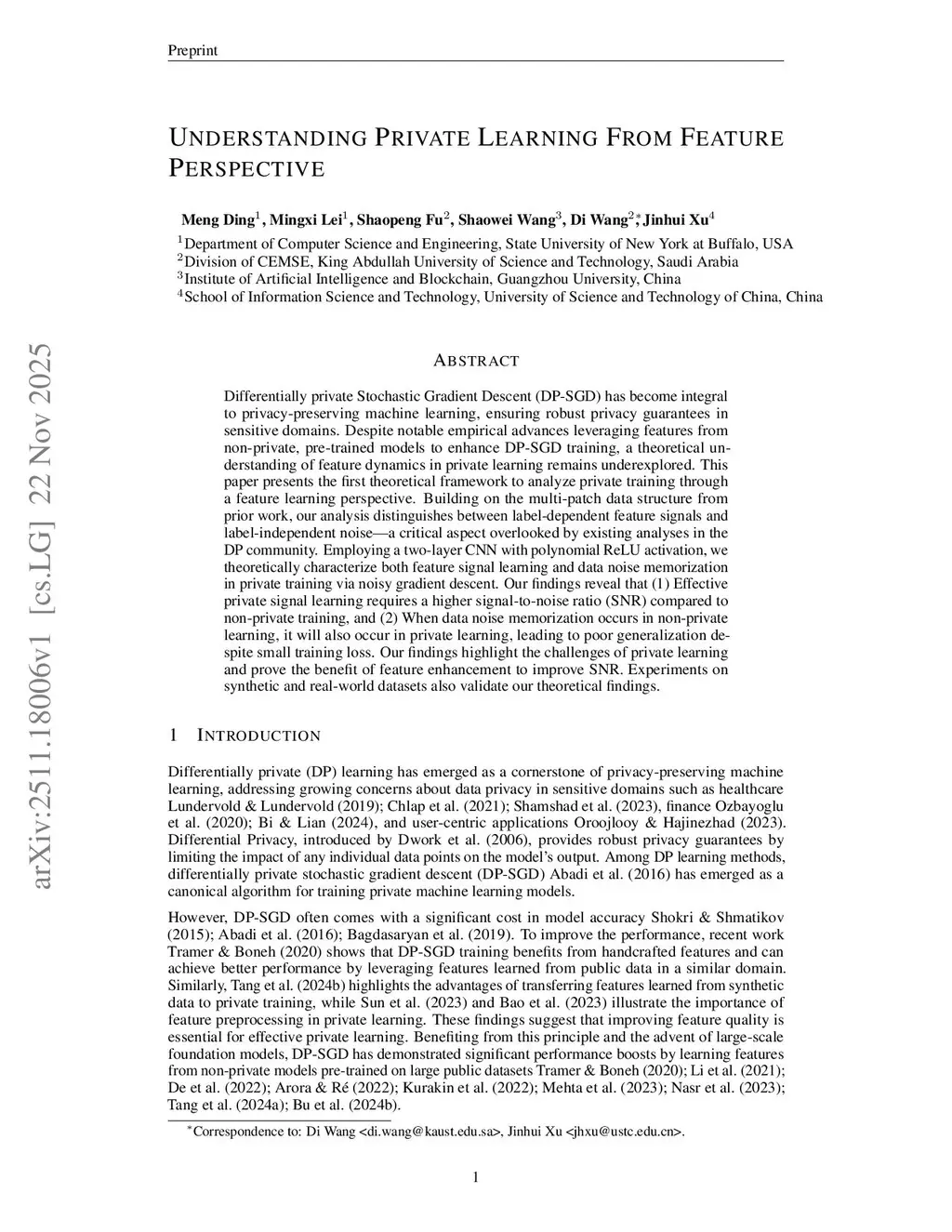
Differentially private Stochastic Gradient Descent (DP-SGD) has become integral to privacy-preserving machine learning, ensuring robust privacy guarantees in sensitive domains. Despite notable empirical advances leveraging features from non-private, pre-trained models to enhance DP-SGD training, a theoretical understanding of feature dynamics in private learning remains underexplored. This paper presents the first theoretical framework to analyze private training through a feature learning perspective. Building on the multi-patch data structure from prior work, our analysis distinguishes between label-dependent feature signals and label-independent noise, a critical aspect overlooked by existing analyses in the DP community. Employing a two-layer CNN with polynomial ReLU activation, we theoretically characterize both feature signal learning and data noise memorization in private training via noisy gradient descent. Our findings reveal that (1) Effective private signal learning requires a higher signal-to-noise ratio (SNR) compared to non-private training, and (2) When data noise memorization occurs in non-private learning, it will also occur in private learning, leading to poor generalization despite small training loss. Our findings highlight the challenges of private learning and prove the benefit of feature enhancement to improve SNR. Experiments on synthetic and real-world datasets also validate our theoretical findings.
View on arXiv