
From Code Foundation Models to Agents and Applications: A Comprehensive Survey and Practical Guide to Code Intelligence
- LLMAGALMELM
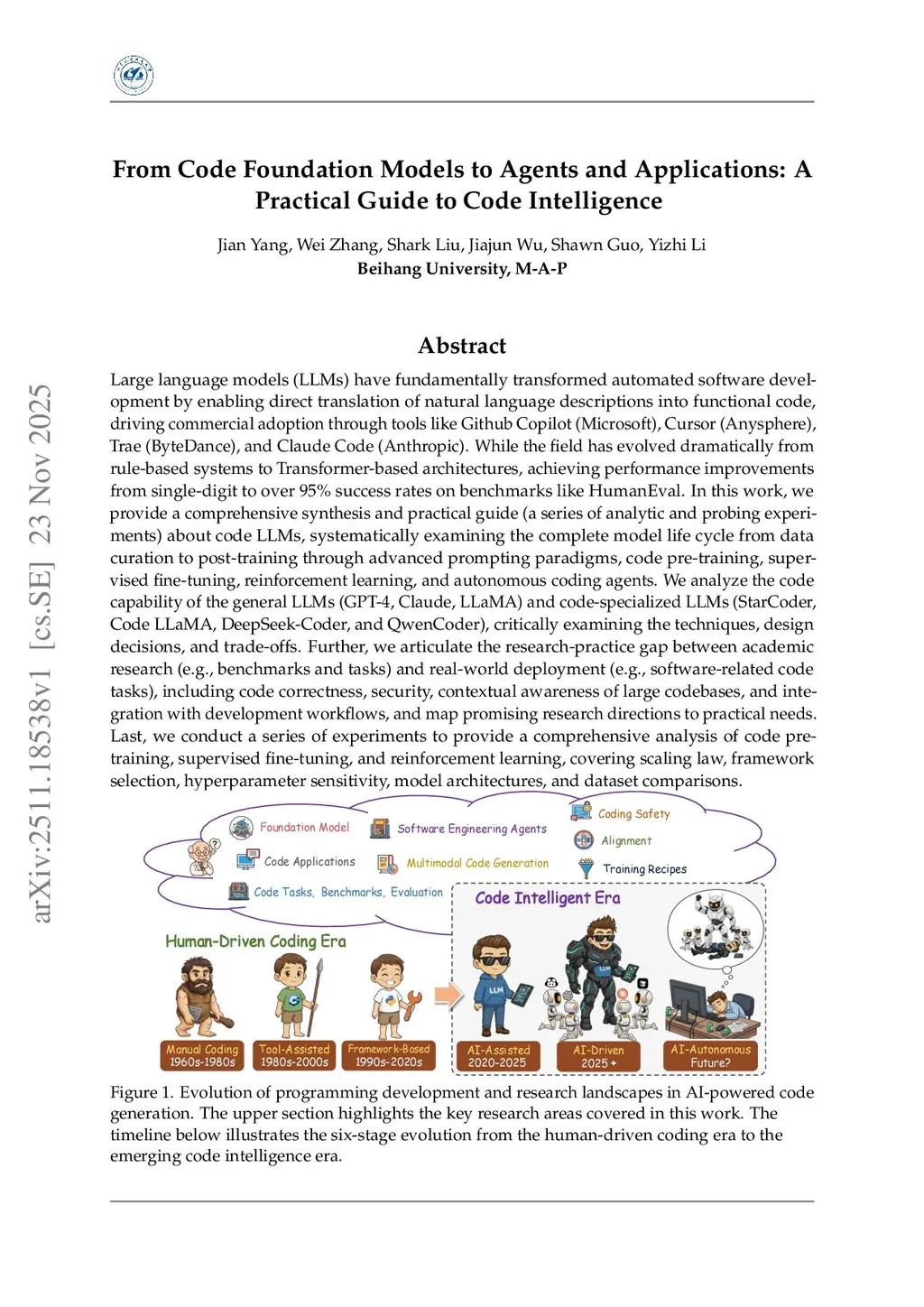
Large language models (LLMs) have fundamentally transformed automated software development by enabling direct translation of natural language descriptions into functional code, driving commercial adoption through tools like Github Copilot (Microsoft), Cursor (Anysphere), Trae (ByteDance), and Claude Code (Anthropic). While the field has evolved dramatically from rule-based systems to Transformer-based architectures, achieving performance improvements from single-digit to over 95\% success rates on benchmarks like HumanEval. In this work, we provide a comprehensive synthesis and practical guide (a series of analytic and probing experiments) about code LLMs, systematically examining the complete model life cycle from data curation to post-training through advanced prompting paradigms, code pre-training, supervised fine-tuning, reinforcement learning, and autonomous coding agents. We analyze the code capability of the general LLMs (GPT-4, Claude, LLaMA) and code-specialized LLMs (StarCoder, Code LLaMA, DeepSeek-Coder, and QwenCoder), critically examining the techniques, design decisions, and trade-offs. Further, we articulate the research-practice gap between academic research (e.g., benchmarks and tasks) and real-world deployment (e.g., software-related code tasks), including code correctness, security, contextual awareness of large codebases, and integration with development workflows, and map promising research directions to practical needs. Last, we conduct a series of experiments to provide a comprehensive analysis of code pre-training, supervised fine-tuning, and reinforcement learning, covering scaling law, framework selection, hyperparameter sensitivity, model architectures, and dataset comparisons.
View on arXiv