
Evaluating Large Language Models on the 2026 Korean CSAT Mathematics Exam: Measuring Mathematical Ability in a Zero-Data-Leakage Setting
- ELMALMLRM
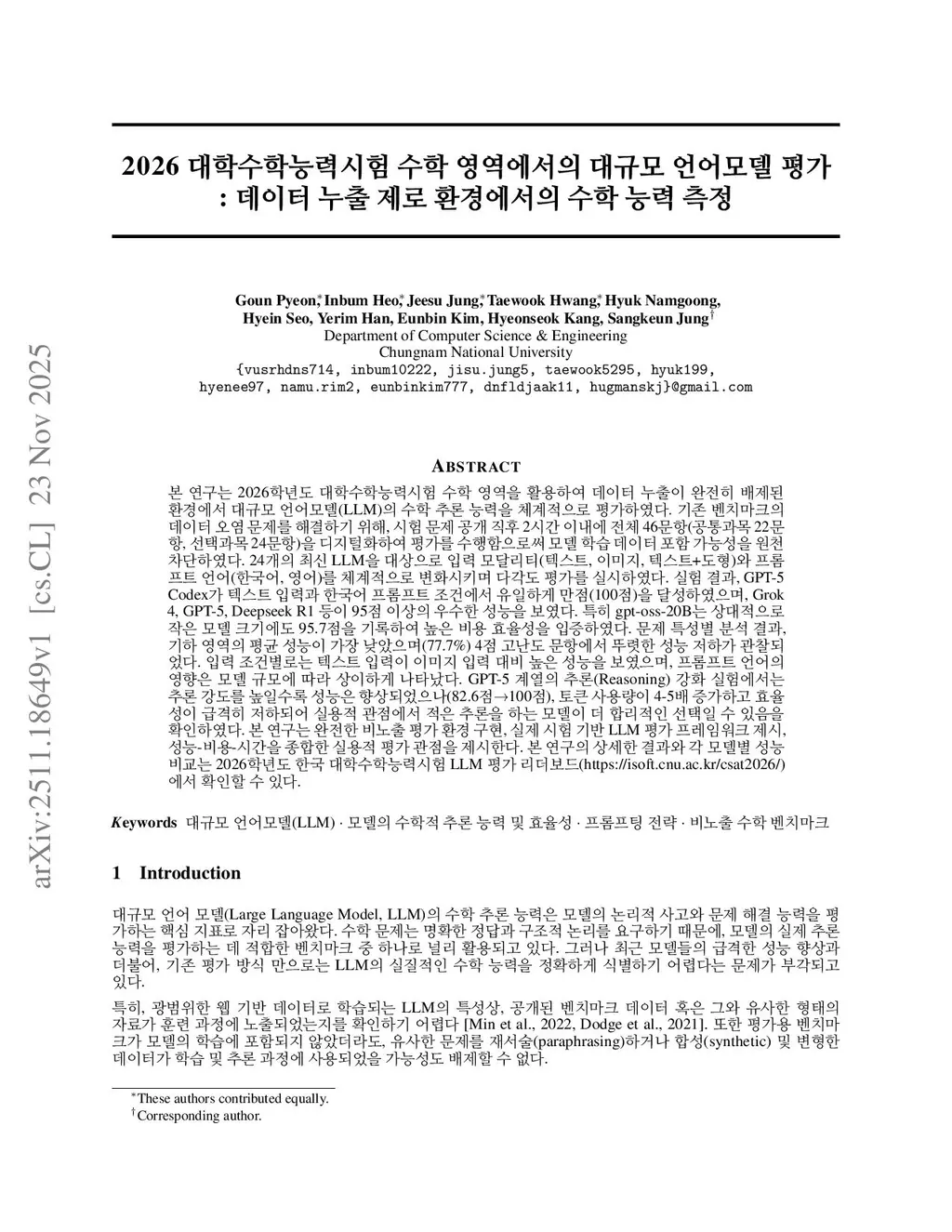
This study systematically evaluated the mathematical reasoning capabilities of Large Language Models (LLMs) using the 2026 Korean College Scholastic Ability Test (CSAT) Mathematics section, ensuring a completely contamination-free evaluation environment. To address data leakage issues in existing benchmarks, we digitized all 46 questions (22 common and 24 elective) within two hours of the exam's public release, eliminating any possibility of inclusion in model training data. We conducted comprehensive evaluations of 24 state-of-the-art LLMs across varying input modalities (Text-only, Image-only, Text+Figure) and prompt languages (Korean, English). The GPT-5 family models achieved perfect scores (100 points) under a limited set of language-modality configurations, while Grok 4, Qwen 3 235B, and Gemini 2.5 pro also scored above 97 points. Notably, gpt-oss-20B achieved 95.7 points despite its relatively small size, demonstrating high cost-effectiveness. Problem-specific analysis revealed Calculus as the weakest domain with significant performance degradation on 4-point high-difficulty problems. Text input consistently outperformed image input, while prompt language effects varied by model scale. In reasoning enhancement experiments with GPT-5 series, increased reasoning intensity improved performance (82.6->100 points) but quadrupled token usage and drastically reduced efficiency, suggesting that models with minimal reasoning may be more practical. This research contributes: (1) implementation of a completely unexposed evaluation environment, (2) a standardized digitization pipeline that converts human-targeted exam materials into LLM-ready evaluation data, and (3) a practical evaluation perspective integrating performance, cost, and time considerations. Detailed results and model comparisons are available at the 2026 Korean CSAT LLM Evaluation Leaderboard;this https URL
View on arXiv