
STAvatar: Soft Binding and Temporal Density Control for Monocular 3D Head Avatars Reconstruction
- 3DGS
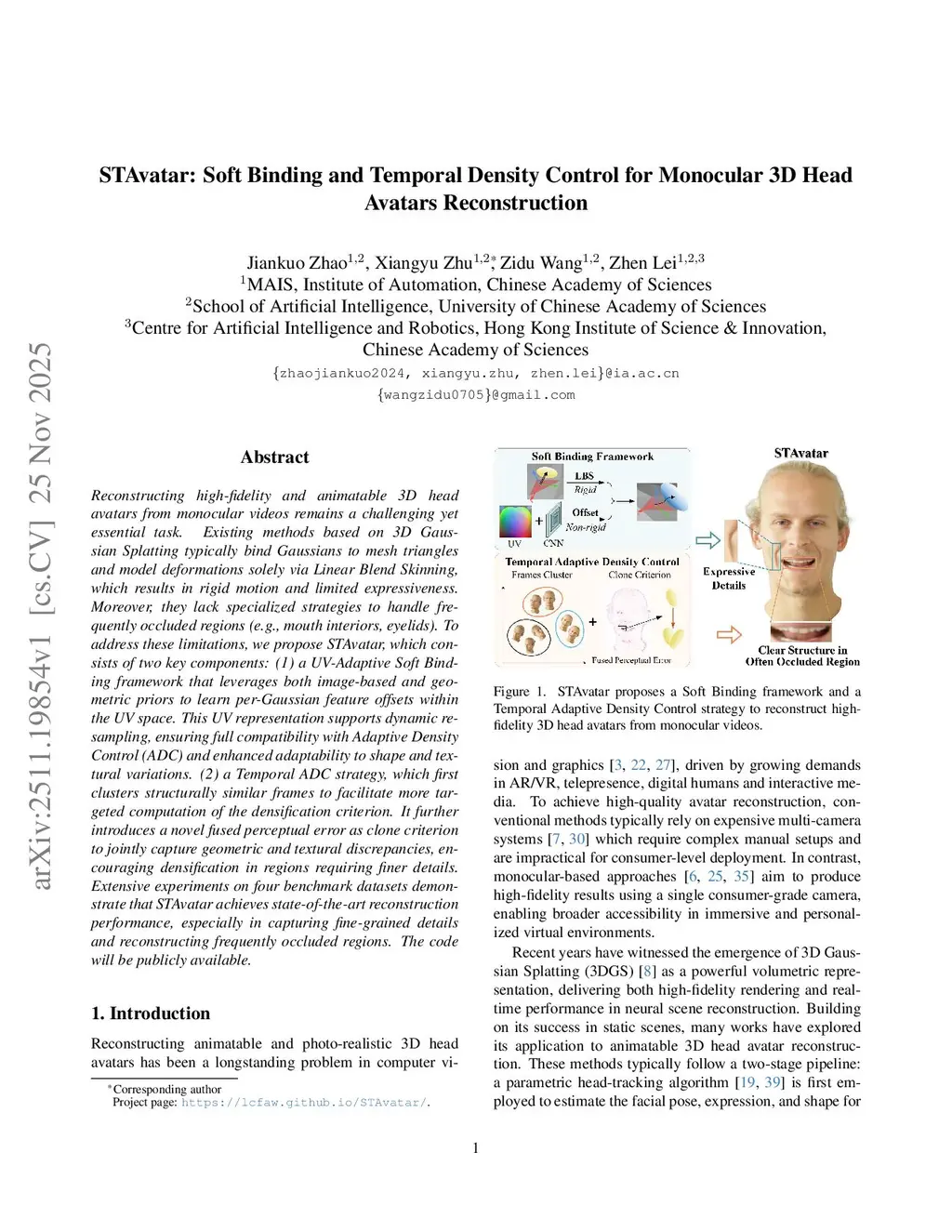
Reconstructing high-fidelity and animatable 3D head avatars from monocular videos remains a challenging yet essential task. Existing methods based on 3D Gaussian Splatting typically bind Gaussians to mesh triangles and model deformations solely via Linear Blend Skinning, which results in rigid motion and limited expressiveness. Moreover, they lack specialized strategies to handle frequently occluded regions (e.g., mouth interiors, eyelids). To address these limitations, we propose STAvatar, which consists of two key components: (1) a UV-Adaptive Soft Binding framework that leverages both image-based and geometric priors to learn per-Gaussian feature offsets within the UV space. This UV representation supports dynamic resampling, ensuring full compatibility with Adaptive Density Control (ADC) and enhanced adaptability to shape and textural variations. (2) a Temporal ADC strategy, which first clusters structurally similar frames to facilitate more targeted computation of the densification criterion. It further introduces a novel fused perceptual error as clone criterion to jointly capture geometric and textural discrepancies, encouraging densification in regions requiring finer details. Extensive experiments on four benchmark datasets demonstrate that STAvatar achieves state-of-the-art reconstruction performance, especially in capturing fine-grained details and reconstructing frequently occluded regions.
View on arXiv