
Multi-GRPO: Multi-Group Advantage Estimation for Text-to-Image Generation with Tree-Based Trajectories and Multiple Rewards
- EGVM
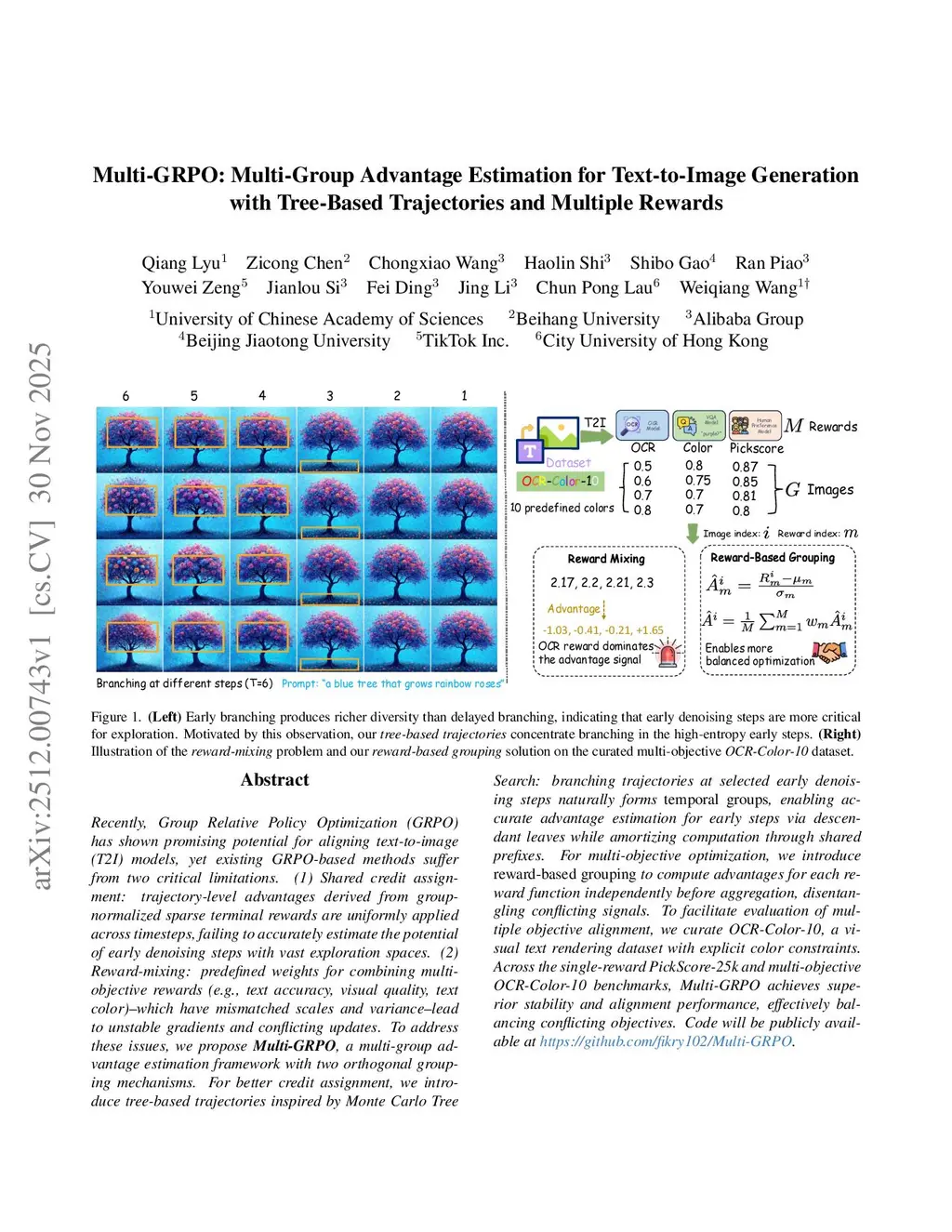
Recently, Group Relative Policy Optimization (GRPO) has shown promising potential for aligning text-to-image (T2I) models, yet existing GRPO-based methods suffer from two critical limitations. (1) \textit{Shared credit assignment}: trajectory-level advantages derived from group-normalized sparse terminal rewards are uniformly applied across timesteps, failing to accurately estimate the potential of early denoising steps with vast exploration spaces. (2) \textit{Reward-mixing}: predefined weights for combining multi-objective rewards (e.g., text accuracy, visual quality, text color)--which have mismatched scales and variances--lead to unstable gradients and conflicting updates. To address these issues, we propose \textbf{Multi-GRPO}, a multi-group advantage estimation framework with two orthogonal grouping mechanisms. For better credit assignment, we introduce tree-based trajectories inspired by Monte Carlo Tree Search: branching trajectories at selected early denoising steps naturally forms \emph{temporal groups}, enabling accurate advantage estimation for early steps via descendant leaves while amortizing computation through shared prefixes. For multi-objective optimization, we introduce \emph{reward-based grouping} to compute advantages for each reward function \textit{independently} before aggregation, disentangling conflicting signals. To facilitate evaluation of multiple objective alignment, we curate \textit{OCR-Color-10}, a visual text rendering dataset with explicit color constraints. Across the single-reward \textit{PickScore-25k} and multi-objective \textit{OCR-Color-10} benchmarks, Multi-GRPO achieves superior stability and alignment performance, effectively balancing conflicting objectives. Code will be publicly available at \href{this https URL}{this https URL}.
View on arXiv