
From Veracity to Diffusion: Adressing Operational Challenges in Moving From Fake-News Detection to Information Disorders
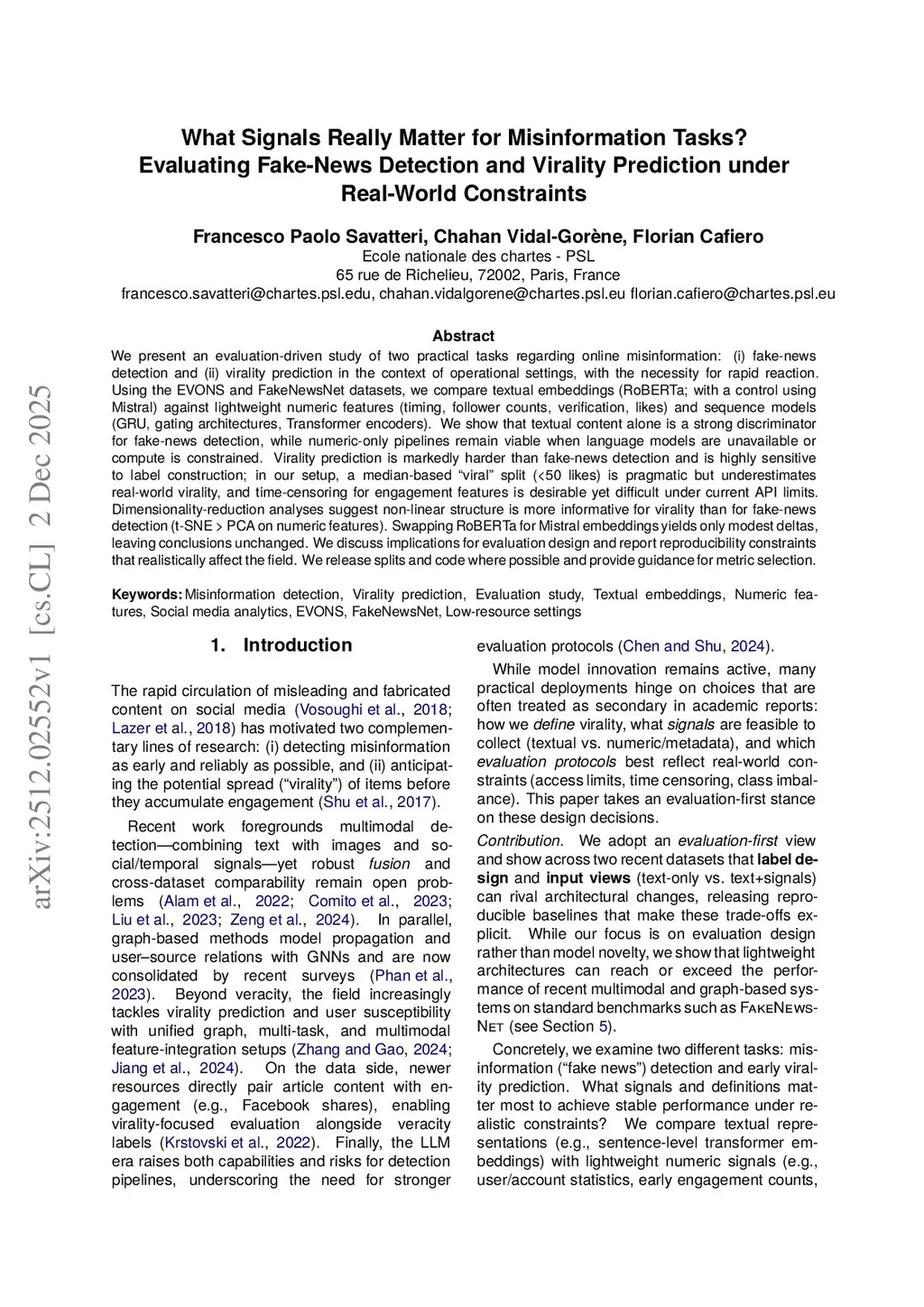
A wide part of research on misinformation has relied lies on fake-news detection, a task framed as the prediction of veracity labels attached to articles or claims. Yet social-science research has repeatedly emphasized that information manipulation goes beyond fabricated content and often relies on amplification dynamics. This theoretical turn has consequences for operationalization in applied social science research. What changes empirically when prediction targets move from veracity to diffusion? And which performance level can be attained in limited resources setups ? In this paper we compare fake-news detection and virality prediction across two datasets, EVONS and FakeNewsNet. We adopt an evaluation-first perspective and examine how benchmark behavior changes when the prediction target shifts from veracity to diffusion. Our experiments show that fake-news detection is comparatively stable once strong textual embeddings are available, whereas virality prediction is much more sensitive to operational choices such as threshold definition and early observation windows. The paper proposes practical ways to operationalize lightweight, transparent pipelines for misinformation-related prediction tasks that can rival with state-of-the-art.
View on arXiv