
Beyond Paired Data: Self-Supervised UAV Geo-Localization from Reference Imagery Alone
- SSL
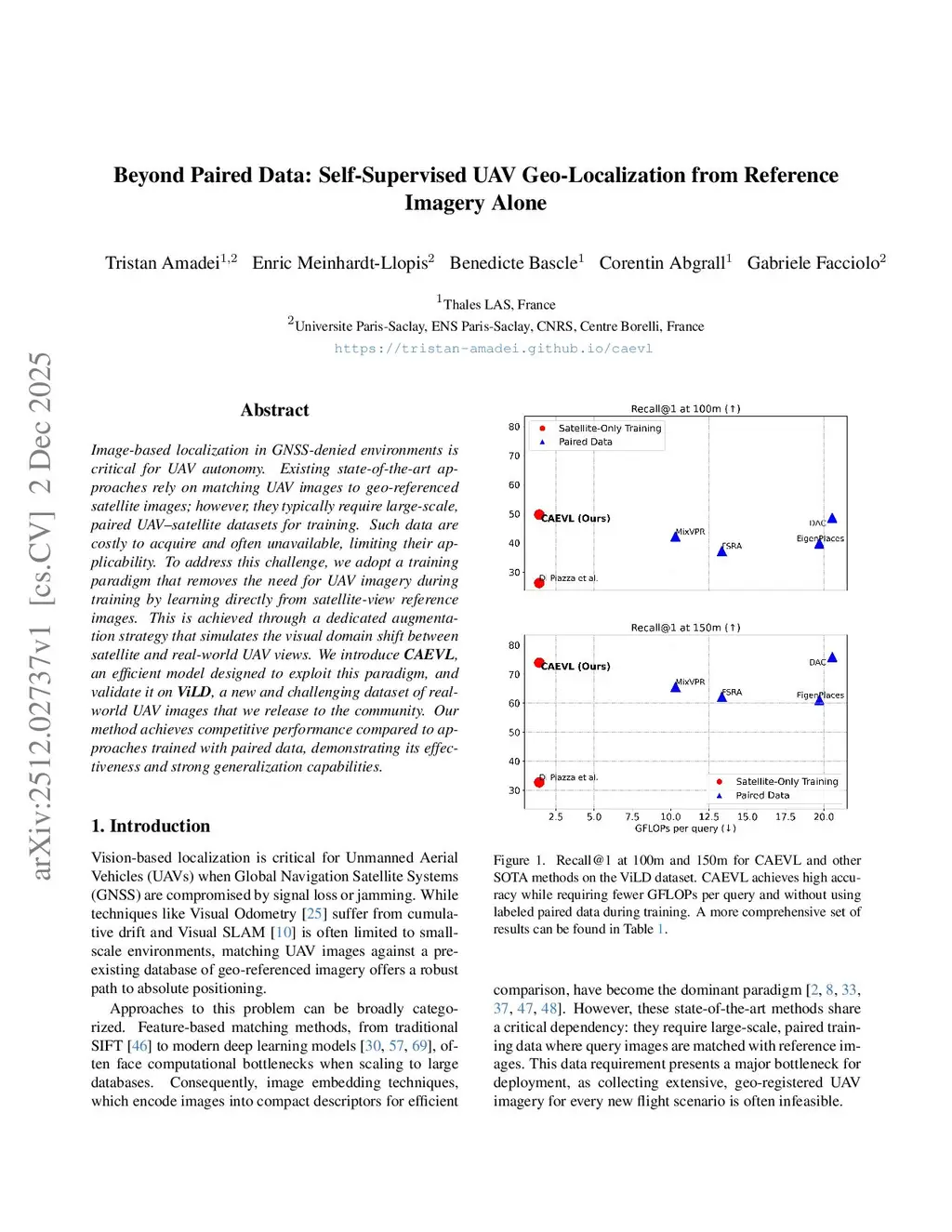
Image-based localization in GNSS-denied environments is critical for UAV autonomy. Existing state-of-the-art approaches rely on matching UAV images to geo-referenced satellite images; however, they typically require large-scale, paired UAV-satellite datasets for training. Such data are costly to acquire and often unavailable, limiting their applicability. To address this challenge, we adopt a training paradigm that removes the need for UAV imagery during training by learning directly from satellite-view reference images. This is achieved through a dedicated augmentation strategy that simulates the visual domain shift between satellite and real-world UAV views. We introduce CAEVL, an efficient model designed to exploit this paradigm, and validate it on ViLD, a new and challenging dataset of real-world UAV images that we release to the community. Our method achieves competitive performance compared to approaches trained with paired data, demonstrating its effectiveness and strong generalization capabilities.
View on arXiv