
Culture Affordance Atlas: Reconciling Object Diversity Through Functional Mapping
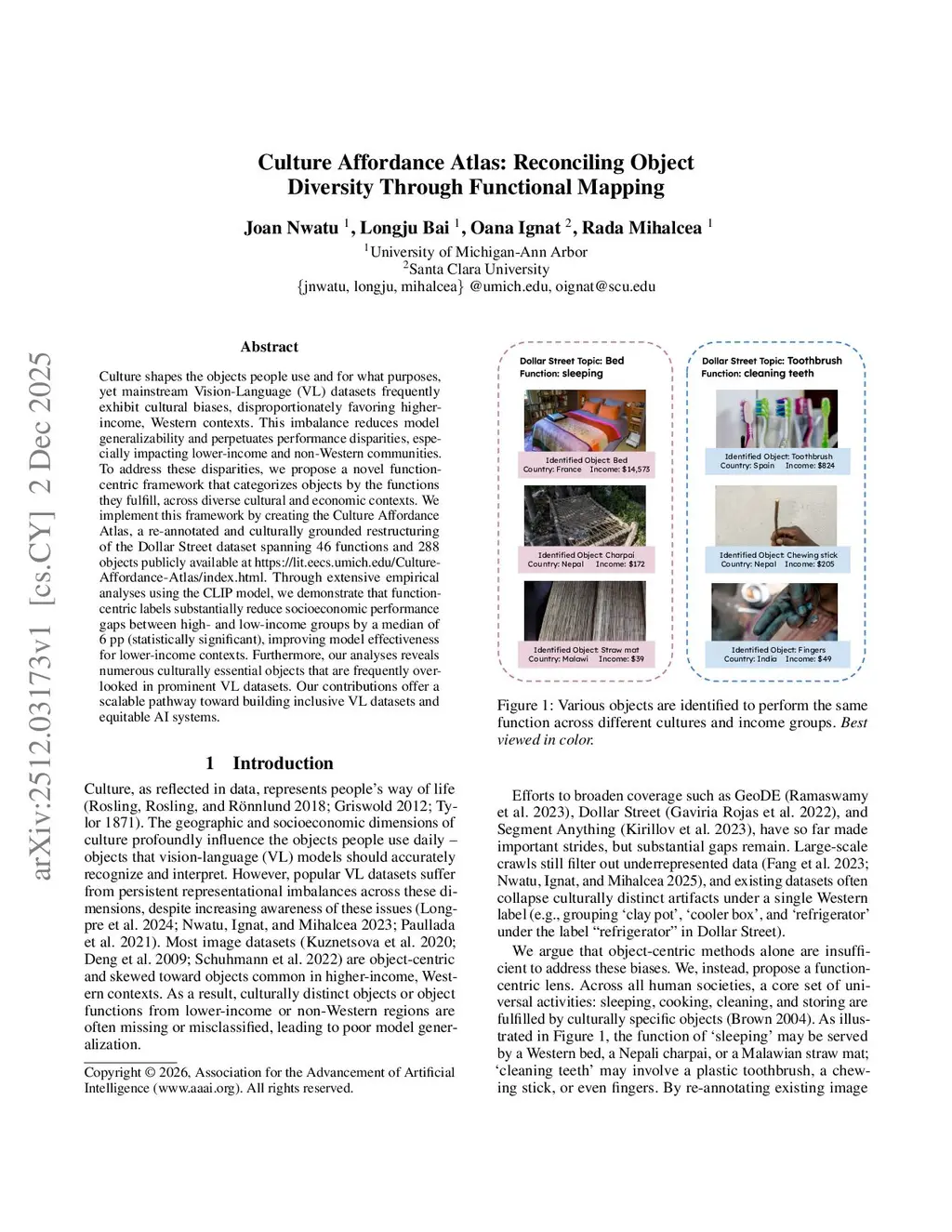
Culture shapes the objects people use and for what purposes, yet mainstream Vision-Language (VL) datasets frequently exhibit cultural biases, disproportionately favoring higher-income, Western contexts. This imbalance reduces model generalizability and perpetuates performance disparities, especially impacting lower-income and non-Western communities. To address these disparities, we propose a novel function-centric framework that categorizes objects by the functions they fulfill, across diverse cultural and economic contexts. We implement this framework by creating the Culture Affordance Atlas, a re-annotated and culturally grounded restructuring of the Dollar Street dataset spanning 46 functions and 288 objects publicly available atthis https URL. Through extensive empirical analyses using the CLIP model, we demonstrate that function-centric labels substantially reduce socioeconomic performance gaps between high- and low-income groups by a median of 6 pp (statistically significant), improving model effectiveness for lower-income contexts. Furthermore, our analyses reveals numerous culturally essential objects that are frequently overlooked in prominent VL datasets. Our contributions offer a scalable pathway toward building inclusive VL datasets and equitable AI systems.
View on arXiv