
OpenTrack3D: Towards Accurate and Generalizable Open-Vocabulary 3D Instance Segmentation
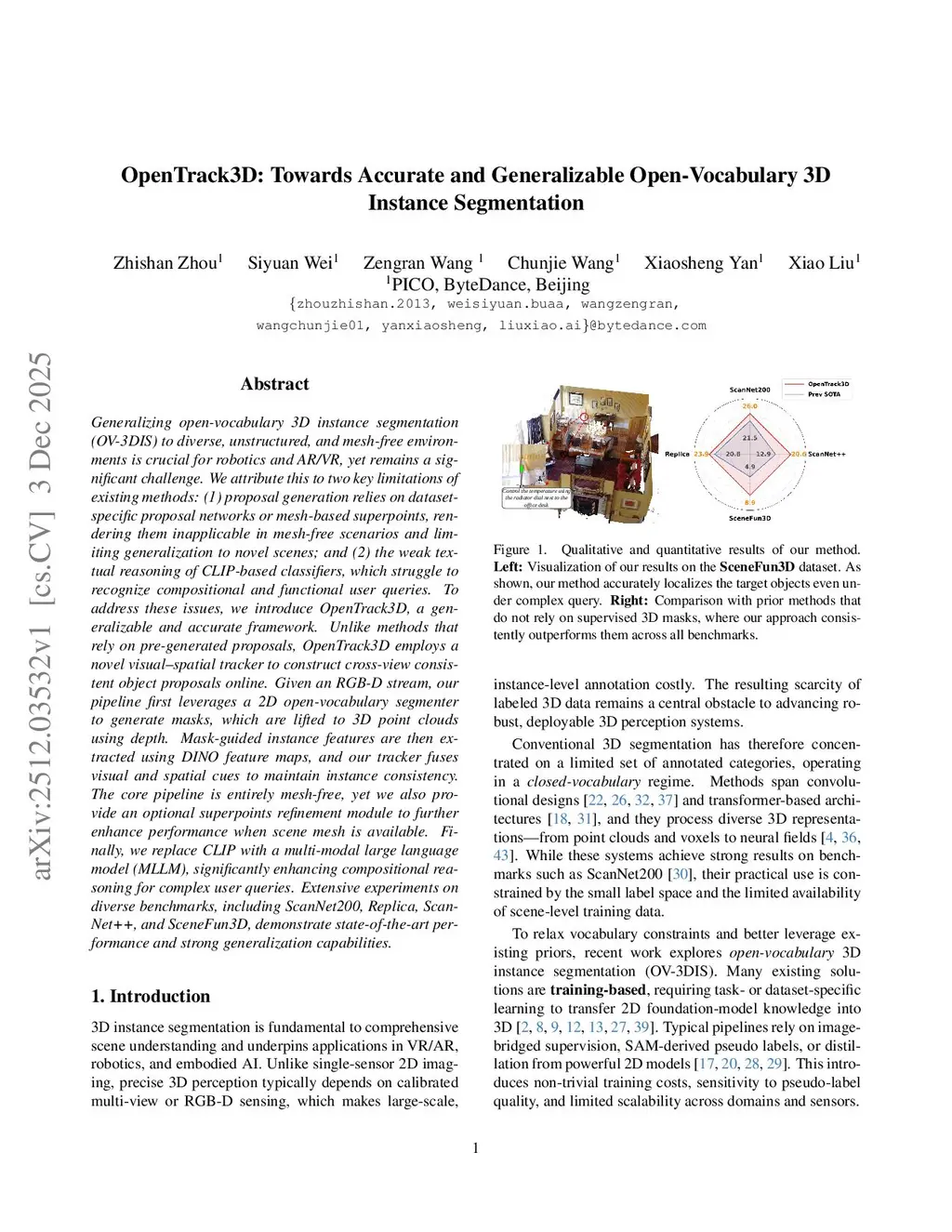
Generalizing open-vocabulary 3D instance segmentation (OV-3DIS) to diverse, unstructured, and mesh-free environments is crucial for robotics and AR/VR, yet remains a significant challenge. We attribute this to two key limitations of existing methods: (1) proposal generation relies on dataset-specific proposal networks or mesh-based superpoints, rendering them inapplicable in mesh-free scenarios and limiting generalization to novel scenes; and (2) the weak textual reasoning of CLIP-based classifiers, which struggle to recognize compositional and functional user queries. To address these issues, we introduce OpenTrack3D, a generalizable and accurate framework. Unlike methods that rely on pre-generated proposals, OpenTrack3D employs a novel visual-spatial tracker to construct cross-view consistent object proposals online. Given an RGB-D stream, our pipeline first leverages a 2D open-vocabulary segmenter to generate masks, which are lifted to 3D point clouds using depth. Mask-guided instance features are then extracted using DINO feature maps, and our tracker fuses visual and spatial cues to maintain instance consistency. The core pipeline is entirely mesh-free, yet we also provide an optional superpoints refinement module to further enhance performance when scene mesh is available. Finally, we replace CLIP with a multi-modal large language model (MLLM), significantly enhancing compositional reasoning for complex user queries. Extensive experiments on diverse benchmarks, including ScanNet200, Replica, ScanNet++, and SceneFun3D, demonstrate state-of-the-art performance and strong generalization capabilities.
View on arXiv