
A Modular Architecture Design for Autonomous Driving Racing in Controlled Environments
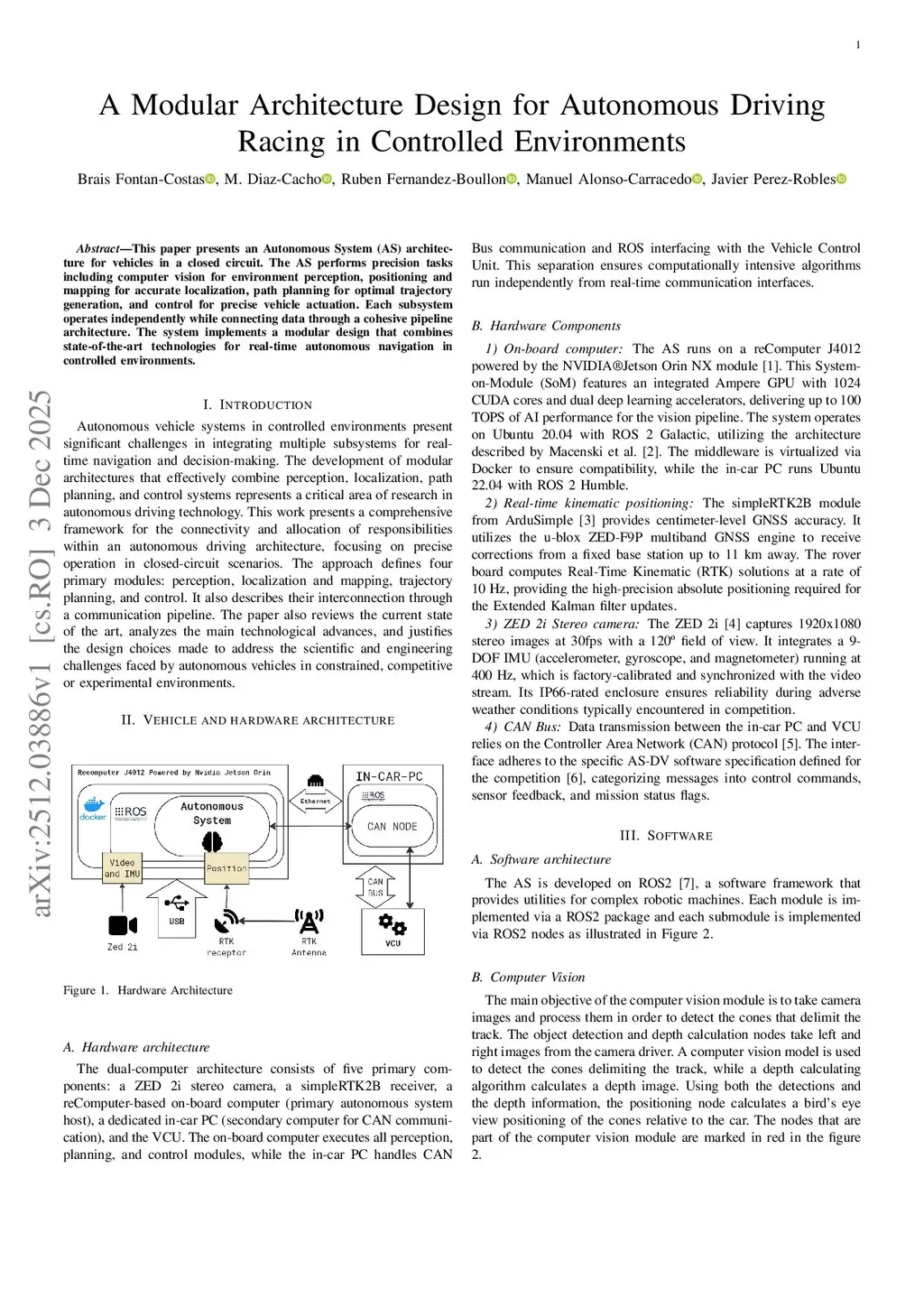
This paper presents a modular autonomous driving architecture for Formula Student Driverless competition vehicles operating in closed-circuit environments. The perception module employs YOLOv11 for real-time traffic cone detection, achieving 0.93 mAP@0.5 on the FSOCO dataset, combined with neural stereo depth estimation from a ZED 2i camera for 3D cone localization with sub-0.5 m median error at distances up to 7 m. State estimation fuses RTK-GNSS positioning and IMU measurements through an Extended Kalman Filter (EKF) based on a kinematic bicycle model, achieving centimeter-level localization accuracy with a 12 cm improvement over raw GNSS. Path planning computes the racing line via cubic spline interpolation on ordered track boundaries and assigns speed profiles constrained by curvature and vehicle dynamics. A regulated pure pursuit controller tracks the planned trajectory with a dynamic lookahead parameterized by speed error. The complete pipeline is implemented as a modular ROS 2 architecture on an NVIDIA Jetson Orin NX platform, with each subsystem deployed as independent nodes communicating through a dual-computer configuration. Experimental validation combines real-world sensor evaluation with simulation-based end-to-end testing, where realistic sensor error distributions are injected to assess system-level performance under representative conditions.
View on arXiv