
AugServe: Adaptive Request Scheduling for Augmented Large Language Model Inference Serving
- RALMAI4TS
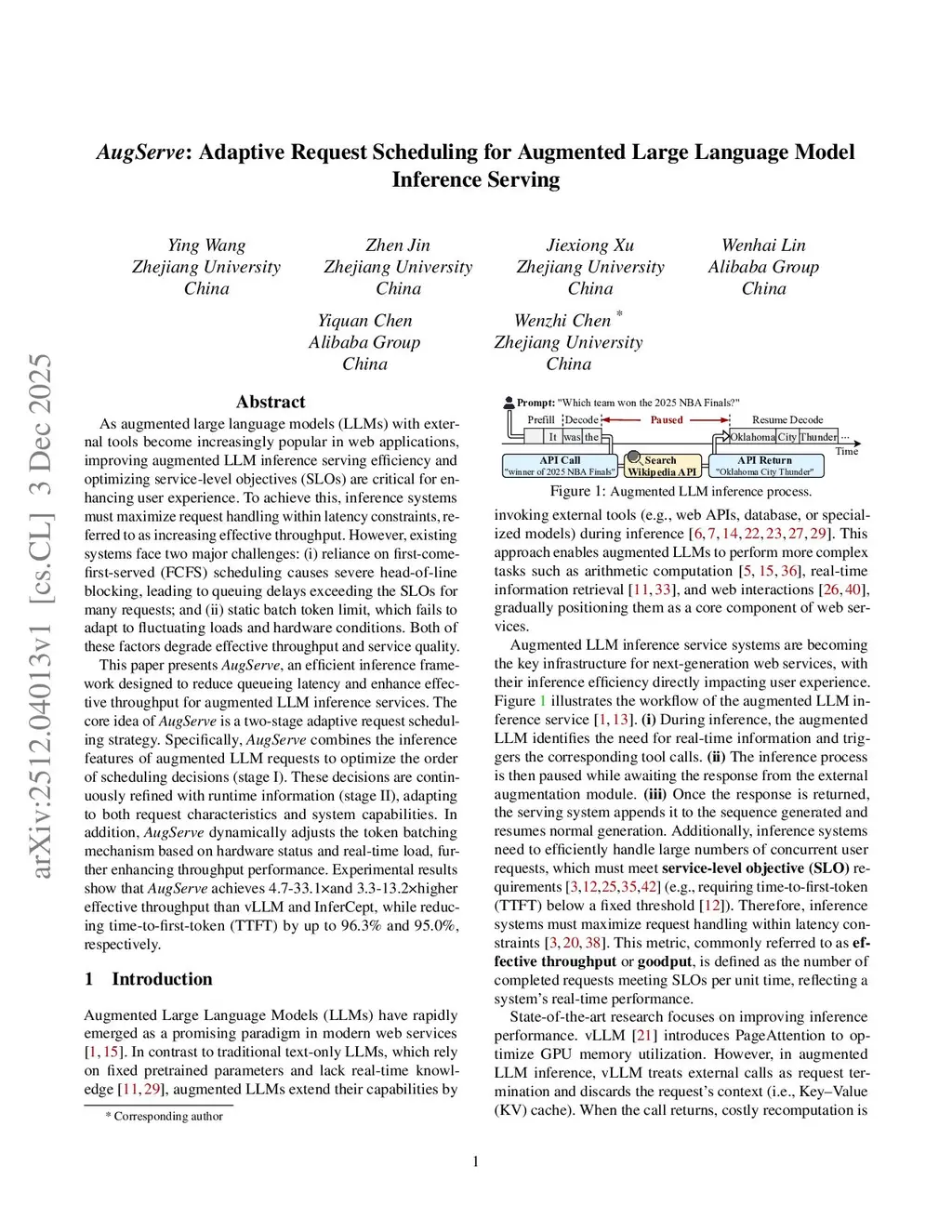
As augmented large language models (LLMs) with external tools become increasingly popular in web applications, improving augmented LLM inference serving efficiency and optimizing service-level objectives (SLOs) are critical for enhancing user experience. To achieve this, inference systems must maximize request handling within latency constraints, referred to as increasing effective throughput. However, existing systems face two major challenges: (i) reliance on first-come-first-served (FCFS) scheduling causes severe head-of-line blocking, leading to queuing delays exceeding the SLOs for many requests; and (ii) static batch token limit, which fails to adapt to fluctuating loads and hardware conditions. Both of these factors degrade effective throughput and service quality.This paper presents AugServe, an efficient inference framework designed to reduce queueing latency and enhance effective throughput for augmented LLM inference services. The core idea of AugServe is a two-stage adaptive request scheduling strategy. Specifically, AugServe combines the inference features of augmented LLM requests to optimize the order of scheduling decisions (stage I). These decisions are continuously refined with runtime information (stage II), adapting to both request characteristics and system capabilities. In addition, AugServe dynamically adjusts the token batching mechanism based on hardware status and real-time load, further enhancing throughput performance. Experimental results show that AugServe achieves 4.7x and 3.3x higher effective throughput than vLLM and InferCept, while reducing time-to-first-token (TTFT) by up to 96.3% and 95.0%, respectively.
View on arXiv