
Long-Horizon Model-Based Offline Reinforcement Learning Without Conservatism
- OffRL
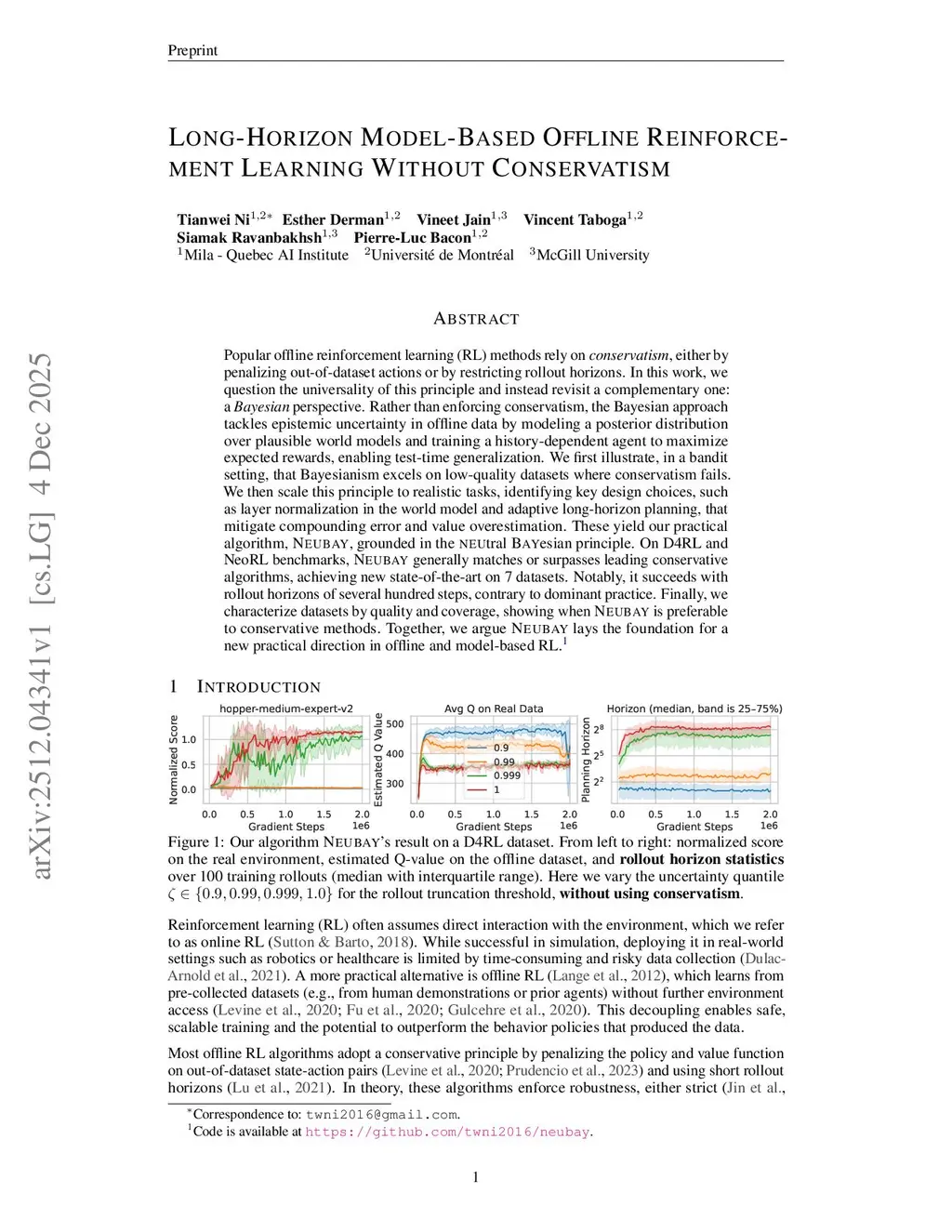
Popular offline reinforcement learning (RL) methods rely on conservatism, either by penalizing out-of-dataset actions or by restricting rollout horizons. In this work, we question the universality of this principle and instead revisit a complementary one: a Bayesian perspective. Rather than enforcing conservatism, the Bayesian approach tackles epistemic uncertainty in offline data by modeling a posterior distribution over plausible world models and training a history-dependent agent to maximize expected rewards, enabling test-time generalization. We first illustrate, in a bandit setting, that Bayesianism excels on low-quality datasets where conservatism fails. We then scale this principle to realistic tasks and show that long-horizon planning is critical for reducing value overestimation once conservatism is removed. To make this feasible, we introduce key design choices for performing and learning from long-horizon rollouts while controlling compounding errors. These yield our algorithm, NEUBAY, grounded in the neutral Bayesian principle. On D4RL and NeoRL benchmarks, NEUBAY generally matches or surpasses leading conservative algorithms, achieving new state-of-the-art on 7 datasets. Notably, it succeeds with rollout horizons of several hundred steps, contrary to dominant practice. Finally, we characterize datasets by quality and coverage, showing when NEUBAY is preferable to conservative methods. Together, we argue NEUBAY lays the foundation for a new practical direction in offline and model-based RL.
View on arXiv