
SEASON: Mitigating Temporal Hallucination in Video Large Language Models via Self-Diagnostic Contrastive Decoding
- MLLM
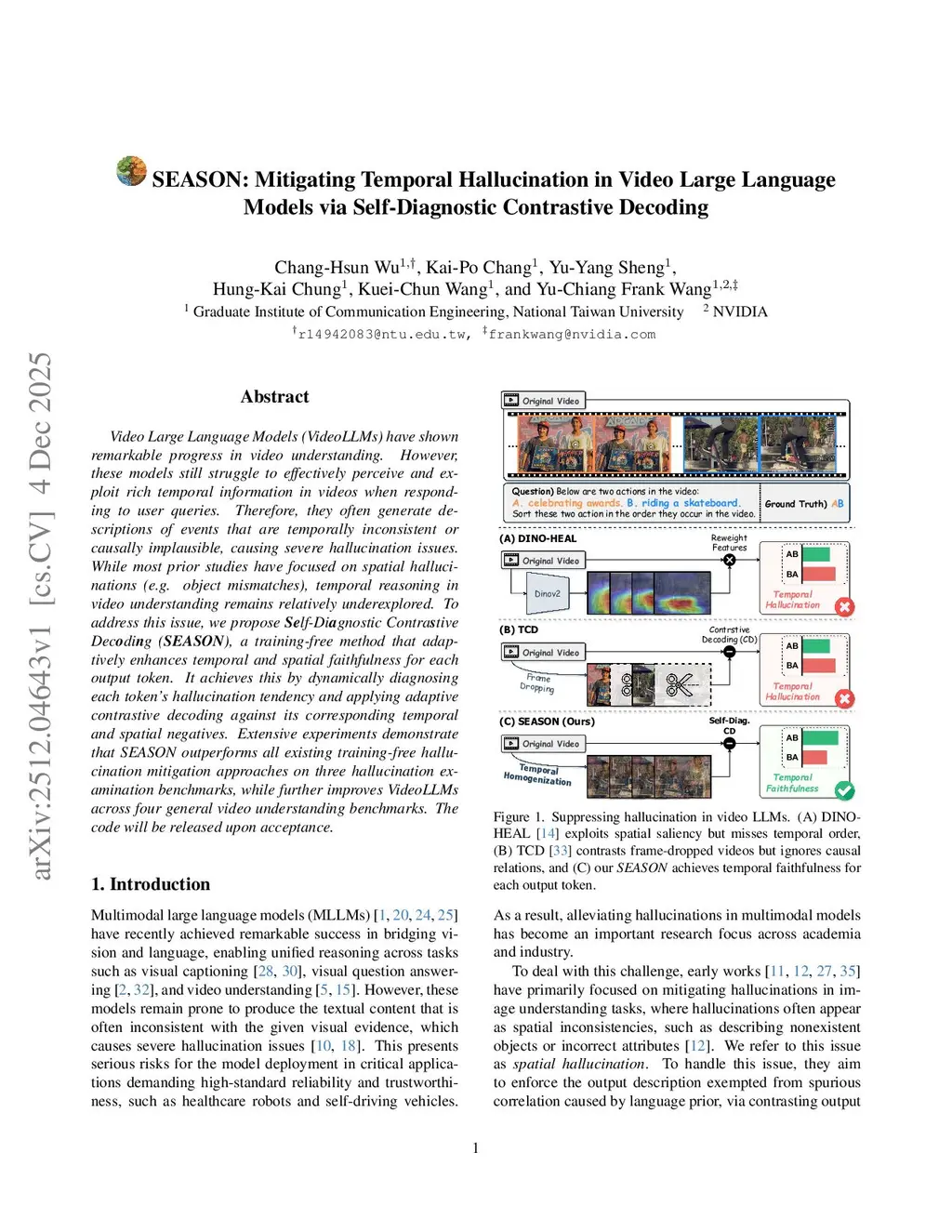
Video Large Language Models (VideoLLMs) have shown remarkable progress in video understanding. However, these models still struggle to effectively perceive and exploit rich temporal information in videos when responding to user queries. Therefore, they often generate descriptions of events that are temporal inconsistent or causally implausible, causing severe hallucination issues. While most prior studies have focused on spatial hallucinations (e.g. object mismatches), temporal reasoning in video understanding remains relatively underexplored. To address this issue, we propose Self-Diagnostic Contrastive Decoding (SEASON), a training-free method that adaptively enhances temporal and spatial faithfulness for each output token. It achieves this by dynamically diagnosing each token's hallucination tendency and applying adaptive contrastive decoding against its corresponding temporal and spatial negatives. Extensive experiments demonstrate that SEASON outperforms all existing training-free hallucination mitigation approaches on three hallucination examination benchmarks, while further improves VideoLLMs across four general video understanding benchmarks. The code will be released upon acceptance.
View on arXiv