
Automated Identification of Incidentalomas Requiring Follow-Up: A Multi-Anatomy Evaluation of LLM-Based and Supervised Approaches
- MedIm
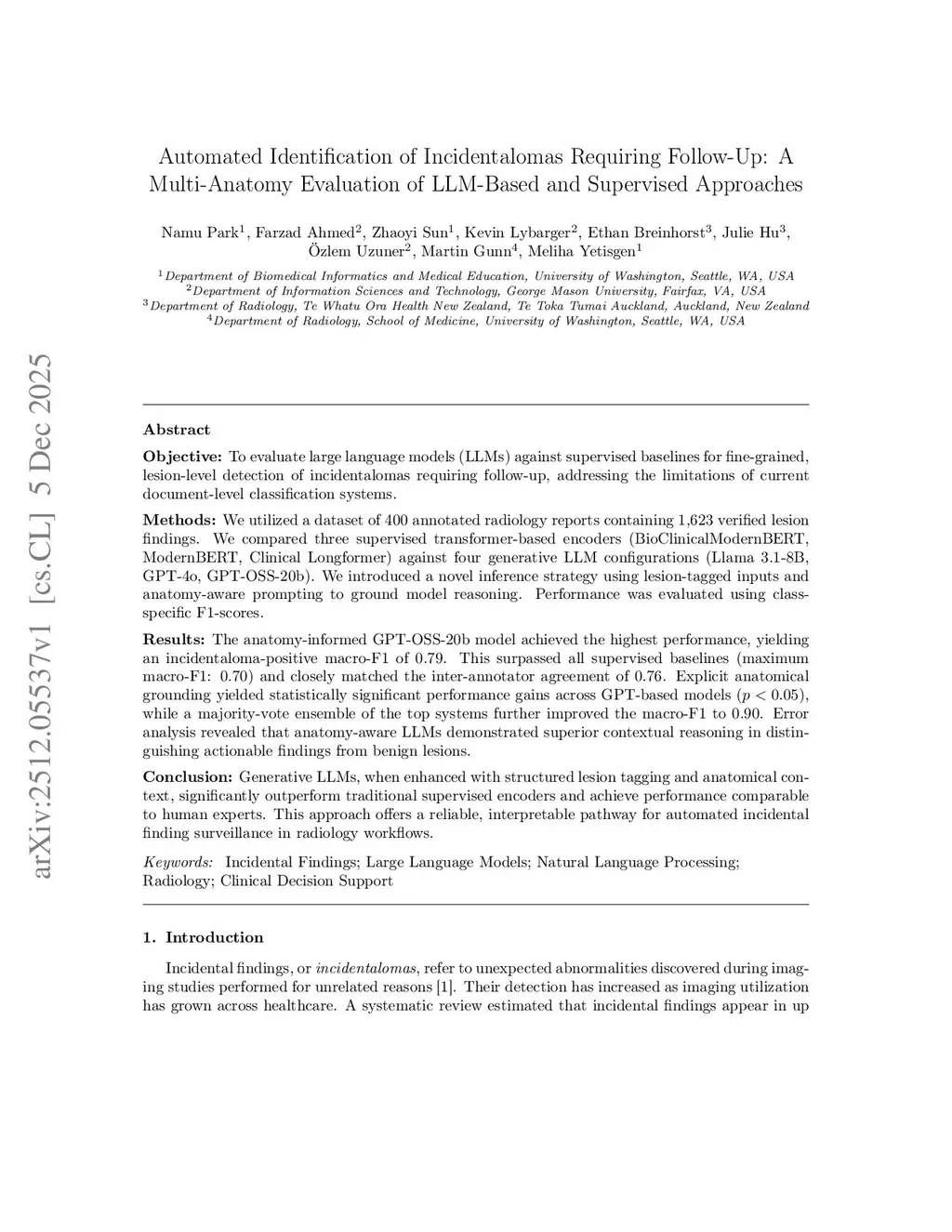
Objective: To evaluate large language models (LLMs) against supervised baselines for fine-grained, lesion-level detection of incidentalomas requiring follow-up, addressing the limitations of current document-level classification systems.Methods: We utilized a dataset of 400 annotated radiology reports containing 1,623 verified lesion findings. We compared three supervised transformer-based encoders (BioClinicalModernBERT, ModernBERT, Clinical Longformer) against four generative LLM configurations (Llama 3.1-8B, GPT-4o, GPT-OSS-20b). We introduced a novel inference strategy using lesion-tagged inputs and anatomy-aware prompting to ground model reasoning. Performance was evaluated using class-specific F1-scores.Results: The anatomy-informed GPT-OSS-20b model achieved the highest performance, yielding an incidentaloma-positive macro-F1 of 0.79. This surpassed all supervised baselines (maximum macro-F1: 0.70) and closely matched the inter-annotator agreement of 0.76. Explicit anatomical grounding yielded statistically significant performance gains across GPT-based models (p < 0.05), while a majority-vote ensemble of the top systems further improved the macro-F1 to 0.90. Error analysis revealed that anatomy-aware LLMs demonstrated superior contextual reasoning in distinguishing actionable findings from benign lesions.Conclusion: Generative LLMs, when enhanced with structured lesion tagging and anatomical context, significantly outperform traditional supervised encoders and achieve performance comparable to human experts. This approach offers a reliable, interpretable pathway for automated incidental finding surveillance in radiology workflows.
View on arXiv