
MIRAGE: Misleading Retrieval-Augmented Generation via Black-box and Query-agnostic Poisoning Attacks
- AAML
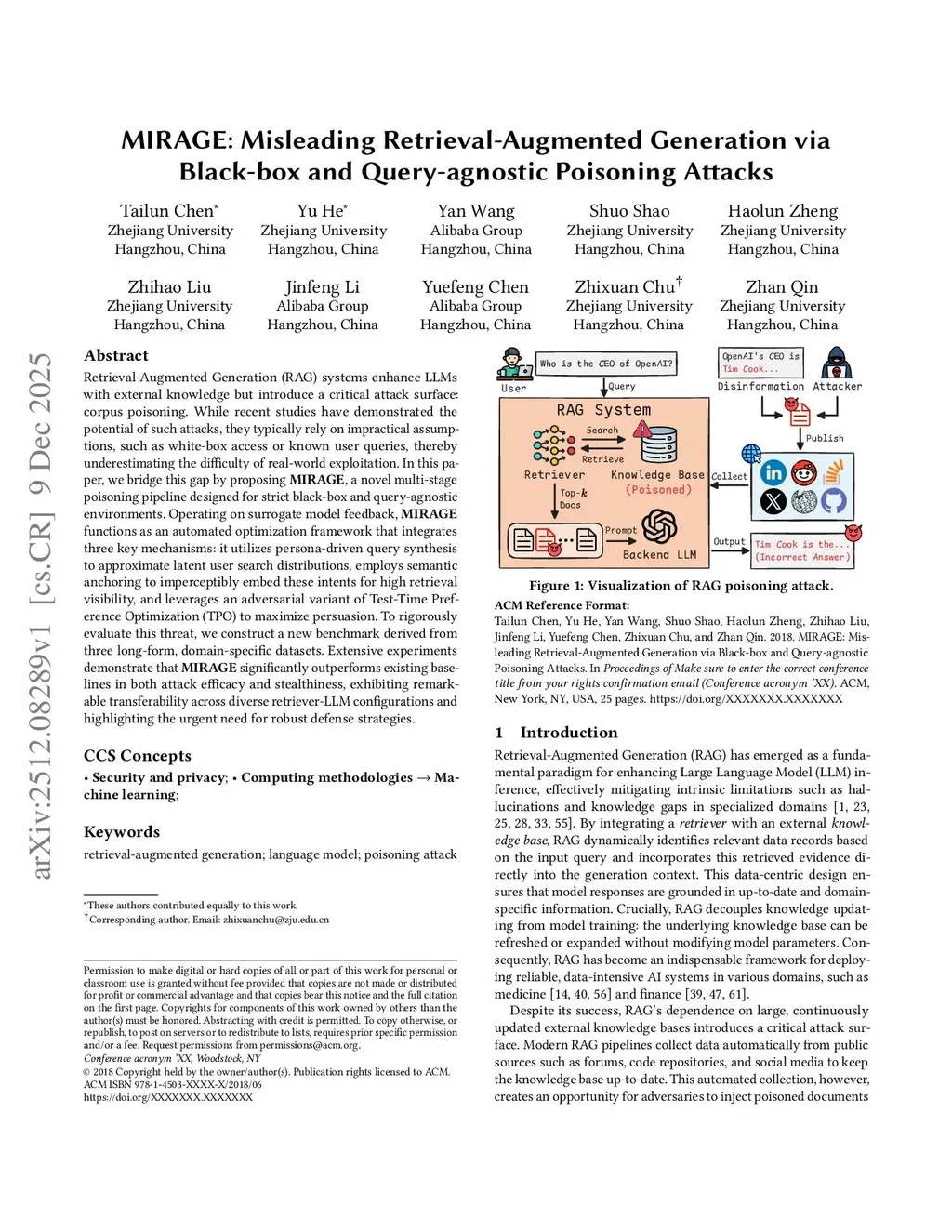
Retrieval-Augmented Generation (RAG) systems enhance LLMs with external knowledge but introduce a critical attack surface: corpus poisoning. While recent studies have demonstrated the potential of such attacks, they typically rely on impractical assumptions, such as white-box access or known user queries, thereby underestimating the difficulty of real-world exploitation. In this paper, we bridge this gap by proposing MIRAGE, a novel multi-stage poisoning pipeline designed for strict black-box and query-agnostic environments. Operating on surrogate model feedback, MIRAGE functions as an automated optimization framework that integrates three key mechanisms: it utilizes persona-driven query synthesis to approximate latent user search distributions, employs semantic anchoring to imperceptibly embed these intents for high retrieval visibility, and leverages an adversarial variant of Test-Time Preference Optimization (TPO) to maximize persuasion. To rigorously evaluate this threat, we construct a new benchmark derived from three long-form, domain-specific datasets. Extensive experiments demonstrate that MIRAGE significantly outperforms existing baselines in both attack efficacy and stealthiness, exhibiting remarkable transferability across diverse retriever-LLM configurations and highlighting the urgent need for robust defense strategies.
View on arXiv