
Non-Resolution Reasoning (NRR): A Computational Framework for Contextual Identity and Ambiguity Preservation
- LRM
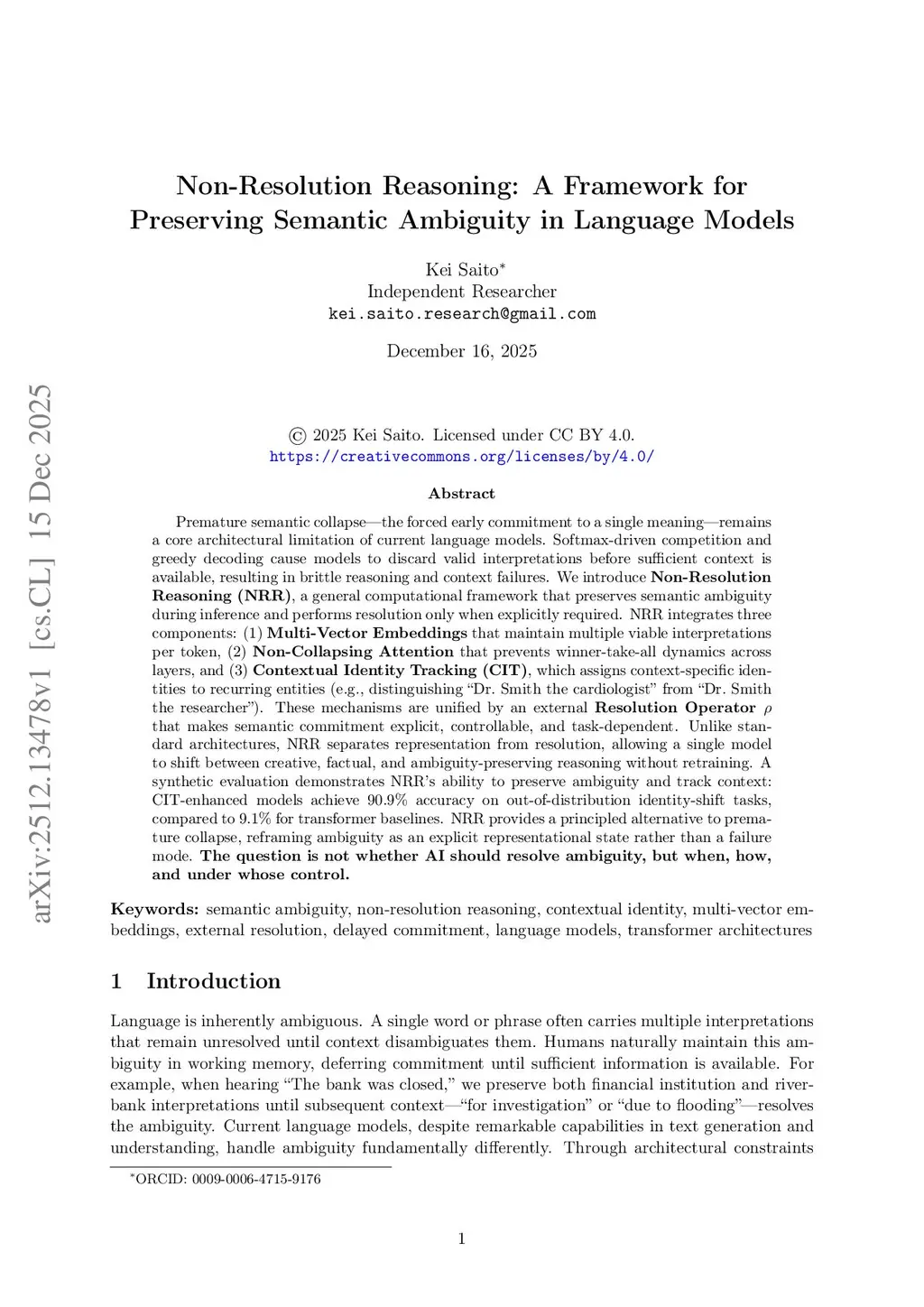
Current AI systems exhibit a fundamental limitation: they resolve ambiguity prematurely. This premature semantic collapse--collapsing multiple valid interpretations into single outputs--stems from classical identity assumptions in neural architectures. We propose Non-Resolution Reasoning (NRR), treating ambiguity retention as a valid reasoning mode. NRR introduces three principles: (1) Non-Identity ()--the same symbol refers to different entities across contexts; (2) Approximate Identity ()--entities share partial overlap without being identical; (3) Non-Resolution--conflicting interpretations coexist without forced convergence. We formalize these through Multi-Vector Embeddings, Non-Collapsing Attention, and Contextual Identity Tracking (CIT). Functional verification via Turn 1 Entropy measurement shows NRR-lite maintains high entropy () at ambiguous turns while standard architectures collapse early (), demonstrating that NRR preserves interpretive flexibility until context arrives. The question is not whether AI should resolve ambiguity, but when, how, and under whose control.
View on arXiv