
SkipCat: Rank-Maximized Low-Rank Compression of Large Language Models via Shared Projection and Block Skipping
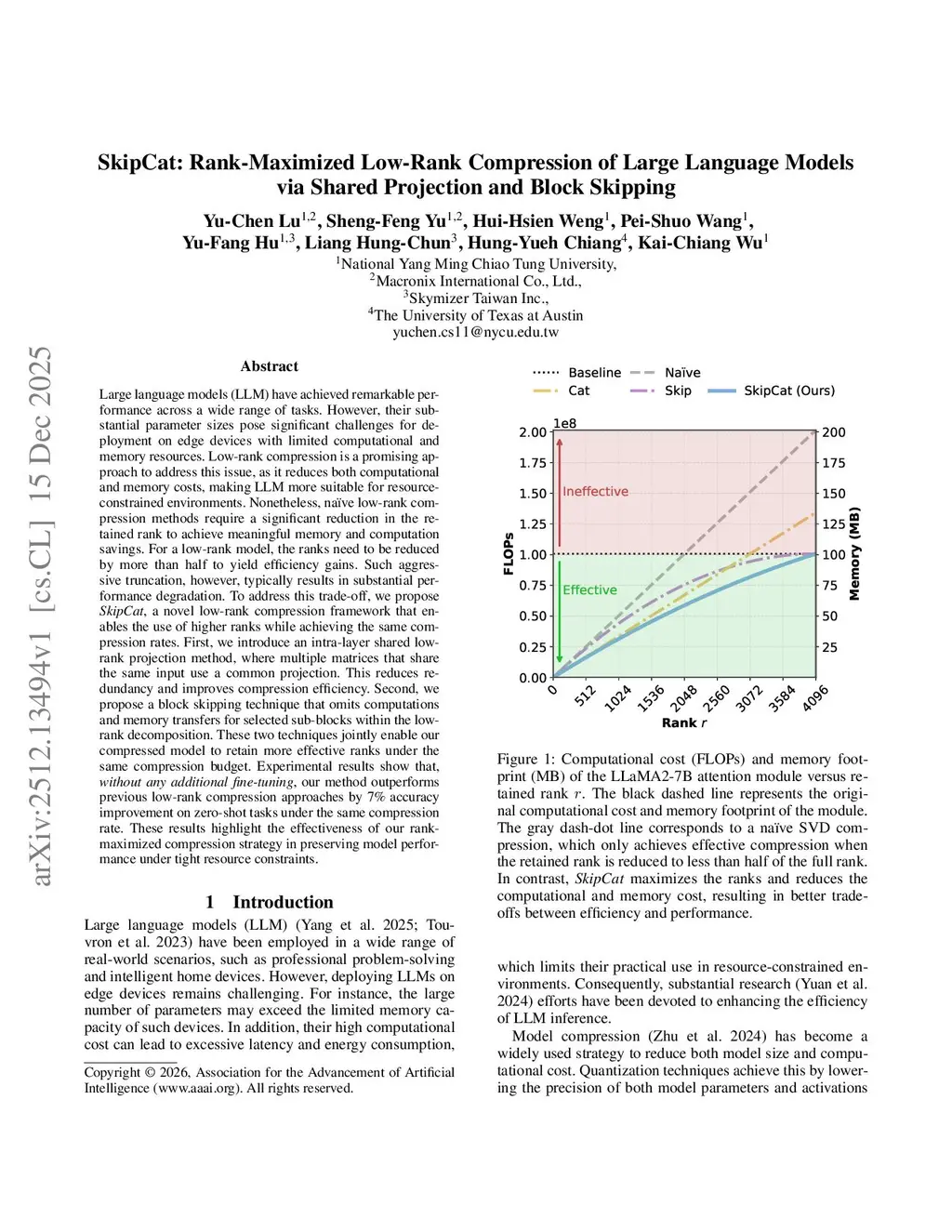
Large language models (LLM) have achieved remarkable performance across a wide range of tasks. However, their substantial parameter sizes pose significant challenges for deployment on edge devices with limited computational and memory resources. Low-rank compression is a promising approach to address this issue, as it reduces both computational and memory costs, making LLM more suitable for resource-constrained environments. Nonetheless, naïve low-rank compression methods require a significant reduction in the retained rank to achieve meaningful memory and computation savings. For a low-rank model, the ranks need to be reduced by more than half to yield efficiency gains. Such aggressive truncation, however, typically results in substantial performance degradation. To address this trade-off, we propose SkipCat, a novel low-rank compression framework that enables the use of higher ranks while achieving the same compression rates. First, we introduce an intra-layer shared low-rank projection method, where multiple matrices that share the same input use a common projection. This reduces redundancy and improves compression efficiency. Second, we propose a block skipping technique that omits computations and memory transfers for selected sub-blocks within the low-rank decomposition. These two techniques jointly enable our compressed model to retain more effective ranks under the same compression budget. Experimental results show that, without any additional fine-tuning, our method outperforms previous low-rank compression approaches by 7% accuracy improvement on zero-shot tasks under the same compression rate. These results highlight the effectiveness of our rank-maximized compression strategy in preserving model performance under tight resource constraints.
View on arXiv