
Explainable Preference Learning: a Decision Tree-based Surrogate Model for Preferential Bayesian Optimization
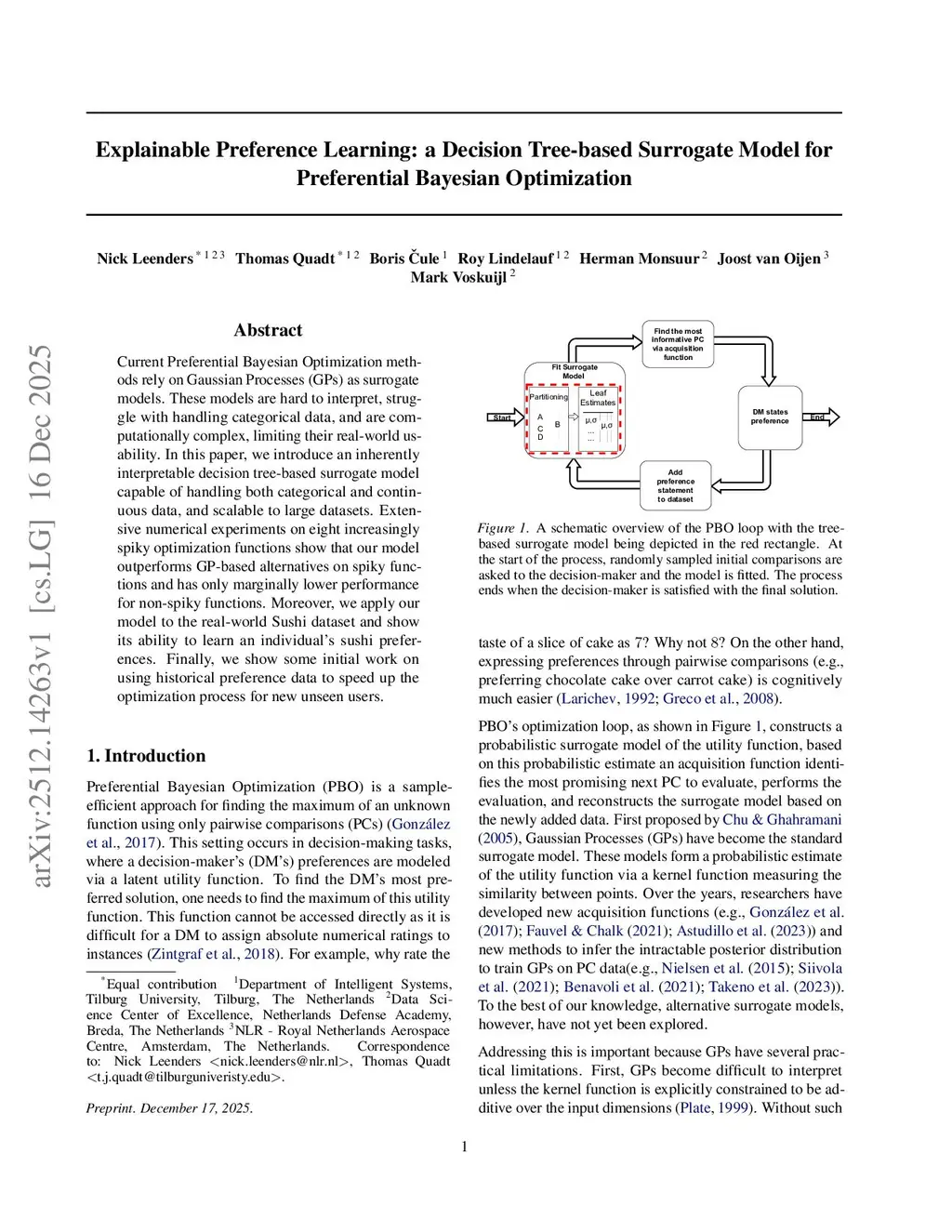
Current Preferential Bayesian Optimization methods rely on Gaussian Processes (GPs) as surrogate models. These models are hard to interpret, struggle with handling categorical data, and are computationally complex, limiting their real-world usability. In this paper, we introduce an inherently interpretable decision tree-based surrogate model capable of handling both categorical and continuous data, and scalable to large datasets. Extensive numerical experiments on eight increasingly spiky optimization functions show that our model outperforms GP-based alternatives on spiky functions and has only marginally lower performance for non-spiky functions. Moreover, we apply our model to the real-world Sushi dataset and show its ability to learn an individual's sushi preferences. Finally, we show some initial work on using historical preference data to speed up the optimization process for new unseen users.
View on arXiv