
EagleVision: A Dual-Stage Framework with BEV-grounding-based Chain-of-Thought for Spatial Intelligence
- LRM
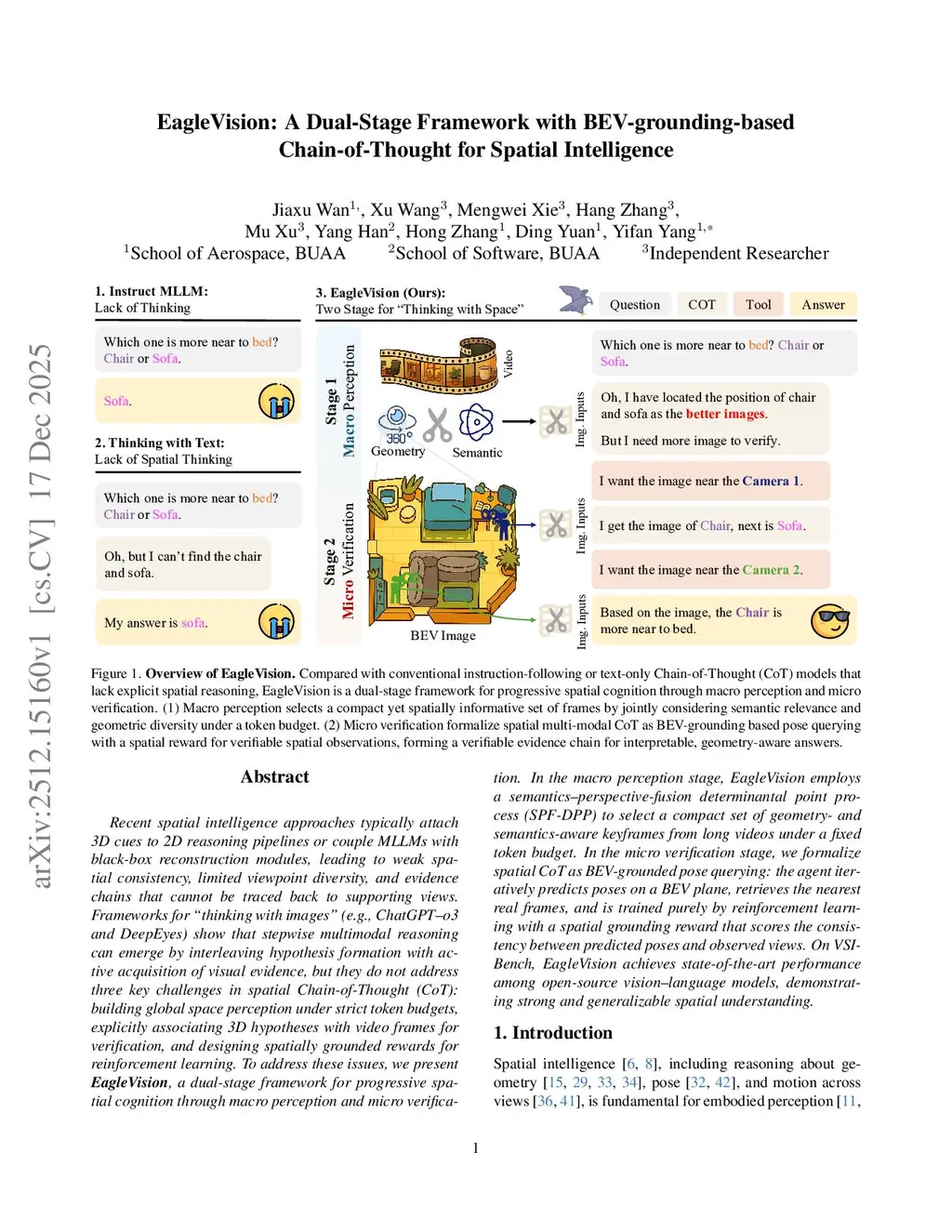
Video-based spatial reasoning -- such as estimating distances, judging directions, or understanding layouts from multiple views -- requires selecting informative frames and, when needed, actively seeking additional viewpoints during inference. Existing multimodal large language models (MLLMs) consume a fixed set of uniformly sampled frames and cannot request new views once reasoning begins, often missing the geometric cues necessary for reliable spatial judgments. We present EagleVision, a dual-stage framework that combines geometry-aware frame selection with active, Bird's-Eye-View (BEV)-grounded reasoning. In the first stage (macro perception), a semantics-perspective-fusion determinantal point process (SPF-DPP) selects a compact set of keyframes that jointly maximize semantic relevance and viewpoint diversity under a fixed token budget. In the second stage (micro verification), the model performs iterative spatial Chain-of-Thought: at each step it can either reason in text or predict a pose on the BEV plane to retrieve the nearest real frame, forming a closed-loop hypothesize-look-verify cycle. The querying policy is trained purely via reinforcement learning with a spatial grounding reward, requiring no human-annotated reasoning traces. On VSI-Bench and SQA3D, EagleVision achieves state-of-the-art performance among open-source vision-language models.
View on arXiv