
Physics-driven human-like working memory outperforms digital networks in dynamic vision
- PINNAI4CE
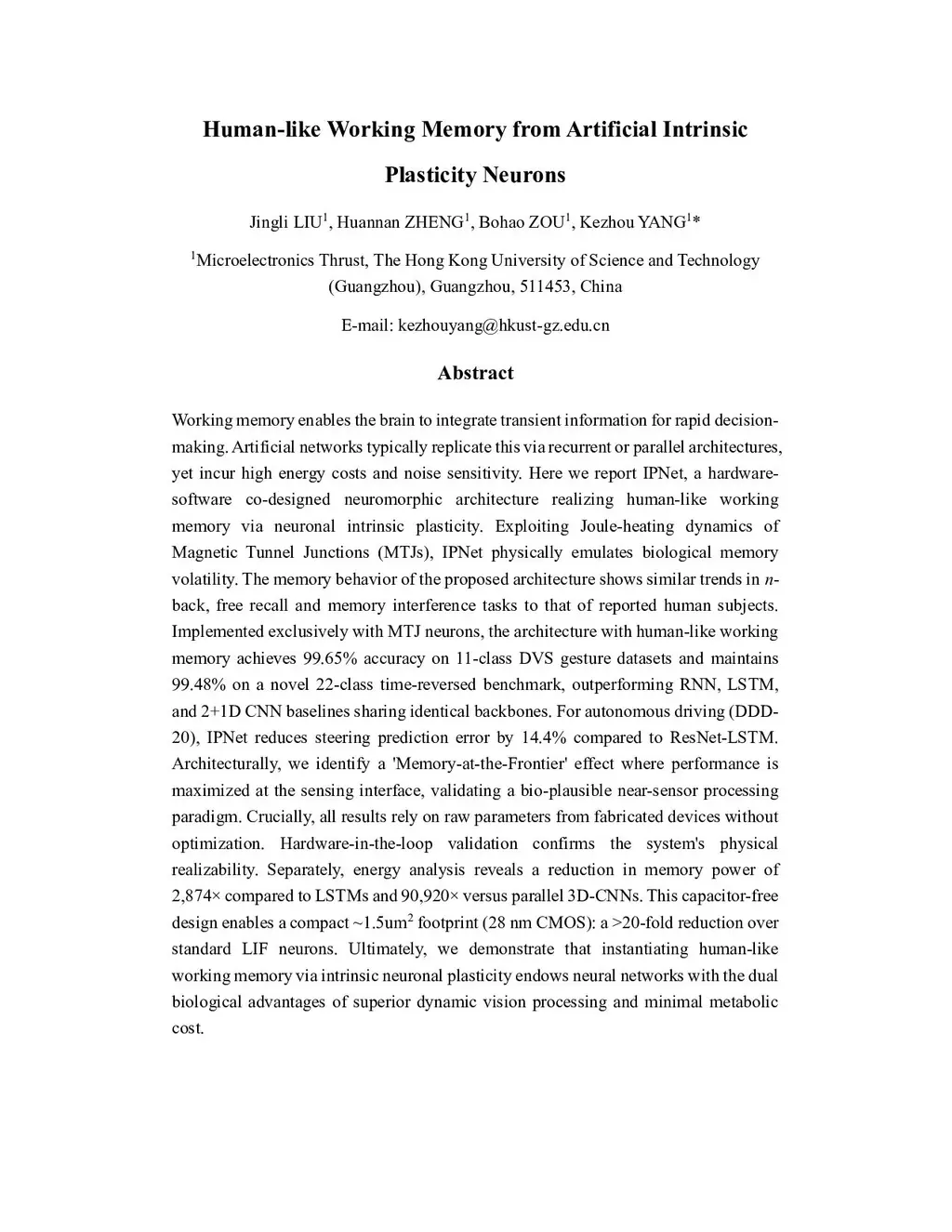
While the unsustainable energy cost of artificial intelligence necessitates physics-driven computing, its performance superiority over full-precision GPUs remains a challenge. We bridge this gap by repurposing the Joule-heating relaxation dynamics of magnetic tunnel junctions, conventionally suppressed as noise, into neuronal intrinsic plasticity, realizing working memory with human-like features. Traditional AI utilizes energy-intensive digital memory that accumulates historical noise in dynamic environments. Conversely, our Intrinsic Plasticity Network (IPNet) leverages thermodynamic dissipation as a temporal filter. We provide direct system-level evidence that this physics-driven memory yields an 18x error reduction compared to spatiotemporal convolutional models in dynamic vision tasks, reducing memory-energy overhead by >90,000x. In autonomous driving, IPNet reduces prediction errors by 12.4% versus recurrent networks. This establishes a neuromorphic paradigm that shatters efficiency limits and surpasses conventional algorithmic performance.
View on arXiv