
Understanding Emotion in Discourse: Recognition Insights and Linguistic Patterns for Generation
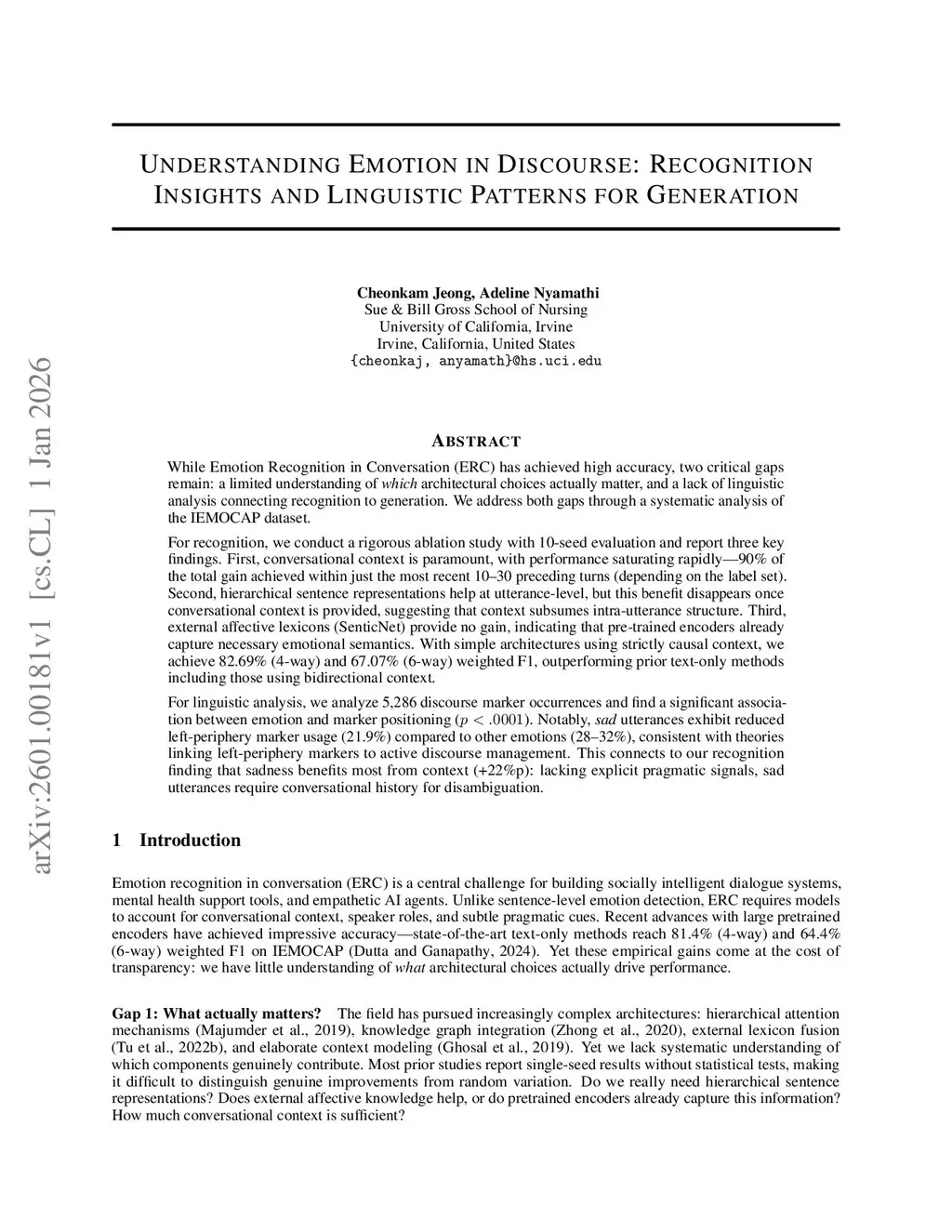
Despite strong recent progress in Emotion Recognition in Conversation (ERC), two gaps remain: we lack clear understanding of which modeling choices materially affect performance, and we have limited linguistic analysis linking recognition findings to actionable generation cues. We address both via a systematic study on IEMOCAP.For recognition, we conduct controlled ablations with 10 random seeds and paired tests (with correction for multiple comparisons), yielding three findings. First, conversational context is dominant: performance saturates quickly, with roughly 90% of gain achieved using only the most recent 10-30 preceding turns. Second, hierarchical sentence representations improve utterance-only recognition (K=0), but the benefit vanishes once turn-level context is available, suggesting conversational history subsumes intra-utterance structure. Third, external affective lexicon (SenticNet) integration does not improve results, consistent with pretrained encoders already capturing affective signal. Under strictly causal (past-only) setting, our simple models attain strong performance (82.69% 4-way; 67.07% 6-way weighted F1).For linguistic analysis, we examine 5,286 discourse-marker occurrences and find reliable association between emotion and marker position (p < 0.0001). Sad utterances show reduced left-periphery marker usage (21.9%) relative to other emotions (28-32%), aligning with accounts linking left-periphery markers to active discourse management. This pattern is consistent with Sad benefiting most from conversational context (+22%p), suggesting sadness relies more on discourse history than overt pragmatic signaling.
View on arXiv