
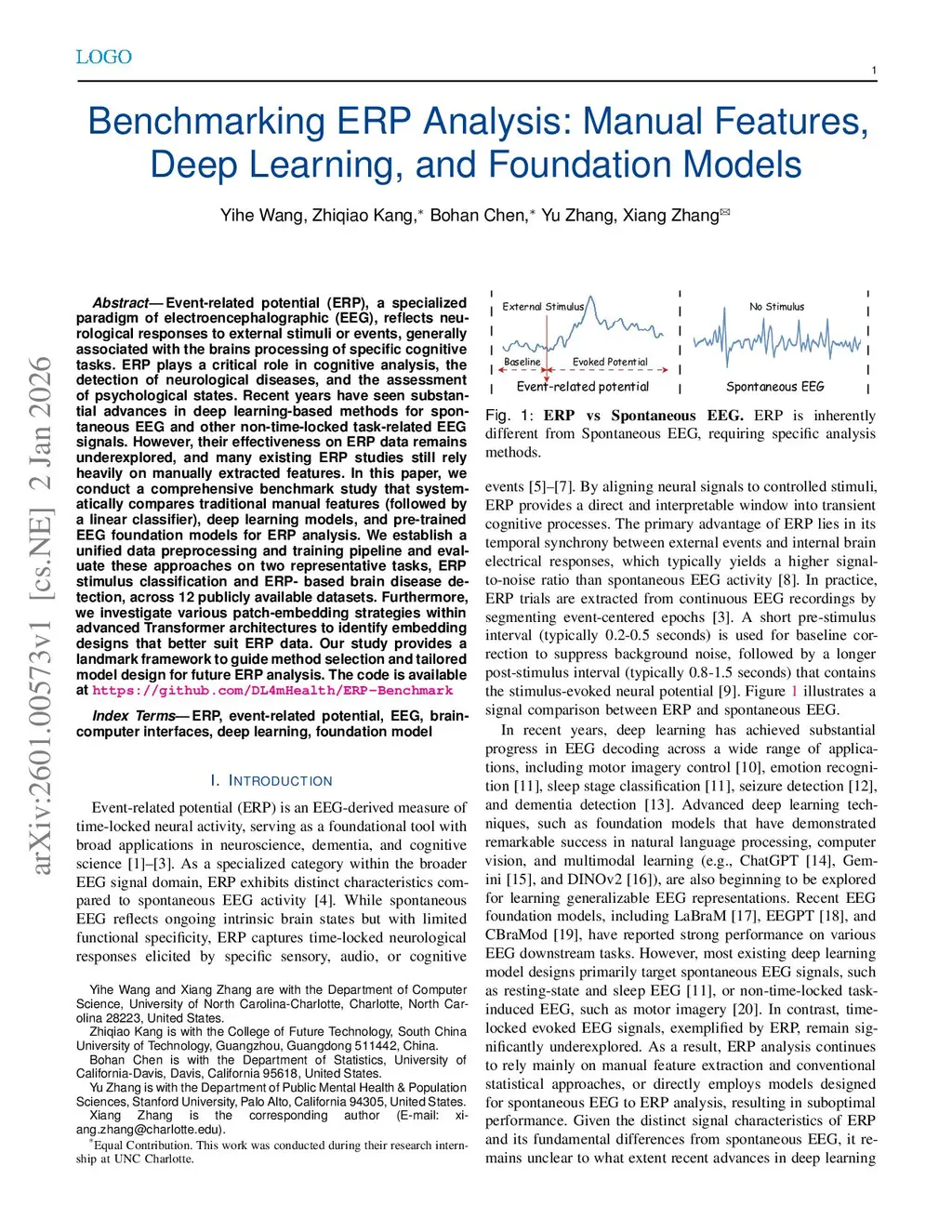
Event-related potential (ERP), a specialized paradigm of electroencephalographic (EEG), reflects neurological responses to external stimuli or events, generally associated with the brain's processing of specific cognitive tasks. ERP plays a critical role in cognitive analysis, the detection of neurological diseases, and the assessment of psychological states. Recent years have seen substantial advances in deep learning-based methods for spontaneous EEG and other non-time-locked task-related EEG signals. However, their effectiveness on ERP data remains underexplored, and many existing ERP studies still rely heavily on manually extracted features. In this paper, we conduct a comprehensive benchmark study that systematically compares traditional manual features (followed by a linear classifier), deep learning models, and pre-trained EEG foundation models for ERP analysis. We establish a unified data preprocessing and training pipeline and evaluate these approaches on two representative tasks, ERP stimulus classification and ERP-based brain disease detection, across 12 publicly available datasets. Furthermore, we investigate various patch-embedding strategies within advanced Transformer architectures to identify embedding designs that better suit ERP data. Our study provides a landmark framework to guide method selection and tailored model design for future ERP analysis. The code is available atthis https URL.
View on arXiv