
Intention Collapse: Intention-Level Metrics for Reasoning in Language Models
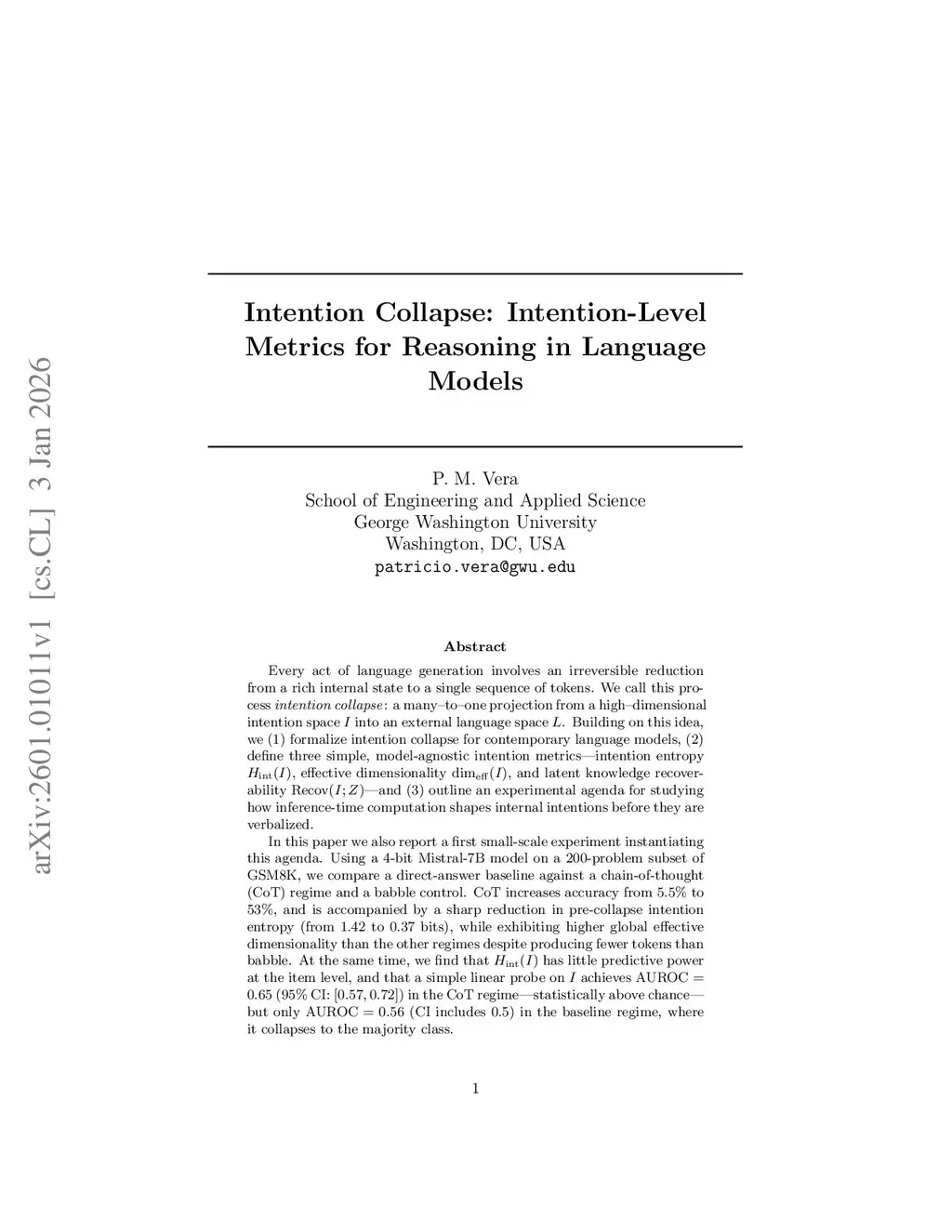
Language generation maps a rich, high-dimensional internal state to a single token sequence. We study this many-to-one mapping through the lens of intention collapse: the projection from an internal intention space I to an external language space L. We introduce three cheap, model-agnostic metrics computed on a pre-collapse state I: (i) intention entropy Hint(I), (ii) effective dimensionality deff(I), and (iii) recoverability Recov(I), operationalized as probe AUROC for predicting eventual success. We evaluate these metrics in a 3x3 study across models (Mistral-7B, LLaMA-3.1-8B, Qwen-2.5-7B) and benchmarks (GSM8K, ARC-Challenge, AQUA-RAT), comparing baseline, chain-of-thought (CoT), and a babble control (n=200 items per cell). CoT increases average accuracy from 34.2% to 47.3% (+13.1 pp), driven by large gains on GSM8K but consistent degradations on ARC-Challenge. Across models, CoT induces distinct entropy regimes relative to baseline, dH = Hint(CoT) - Hint(Base): Mistral shows dH < 0 (lower-entropy CoT), whereas LLaMA shows dH > 0 (higher-entropy CoT), highlighting heterogeneity in CoT-induced internal uncertainty. Finally, probe AUROC is significantly above chance in a subset of settings and can dissociate from behavioral accuracy (e.g., high AUROC alongside lower CoT accuracy on ARC-Challenge for Qwen), suggesting that informative internal signal is not always reliably converted into a final discrete decision under constrained response formats.
View on arXiv