
S2M-Net: Spectral-Spatial Mixing for Medical Image Segmentation with Morphology-Aware Adaptive Loss
- MedIm
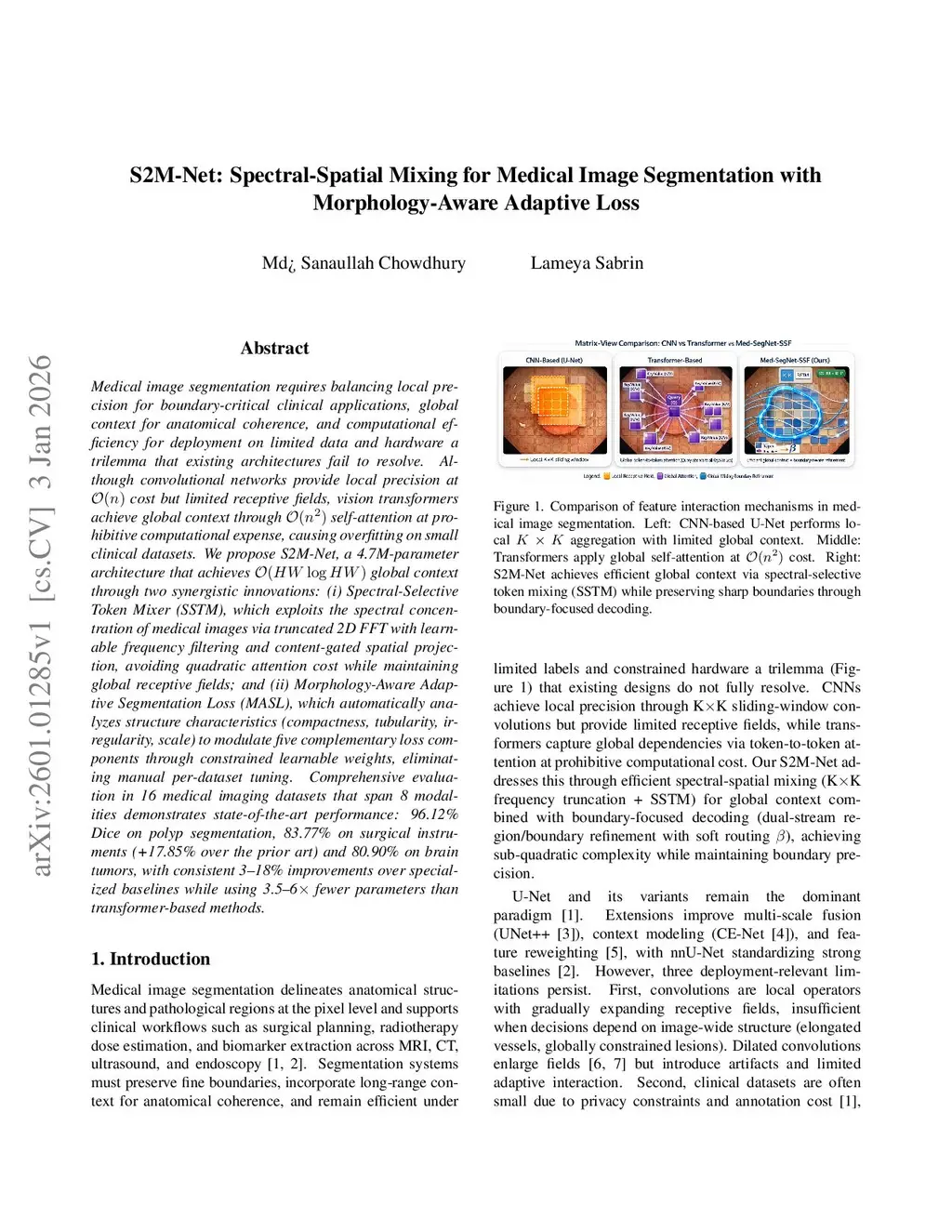
Medical image segmentation requires balancing local precision for boundary-critical clinical applications, global context for anatomical coherence, and computational efficiency for deployment on limited data and hardware a trilemma that existing architectures fail to resolve. Although convolutional networks provide local precision at cost but limited receptive fields, vision transformers achieve global context through self-attention at prohibitive computational expense, causing overfitting on small clinical datasets. We propose S2M-Net, a 4.7M-parameter architecture that achieves global context through two synergistic innovations: (i) Spectral-Selective Token Mixer (SSTM), which exploits the spectral concentration of medical images via truncated 2D FFT with learnable frequency filtering and content-gated spatial projection, avoiding quadratic attention cost while maintaining global receptive fields; and (ii) Morphology-Aware Adaptive Segmentation Loss (MASL), which automatically analyzes structure characteristics (compactness, tubularity, irregularity, scale) to modulate five complementary loss components through constrained learnable weights, eliminating manual per-dataset tuning. Comprehensive evaluation in 16 medical imaging datasets that span 8 modalities demonstrates state-of-the-art performance: 96.12\% Dice on polyp segmentation, 83.77\% on surgical instruments (+17.85\% over the prior art) and 80.90\% on brain tumors, with consistent 3-18\% improvements over specialized baselines while using 3.5--6 fewer parameters than transformer-based methods.
View on arXiv