
Multi-Subspace Multi-Modal Modeling for Diffusion Models: Estimation, Convergence and Mixture of Experts
- DiffM
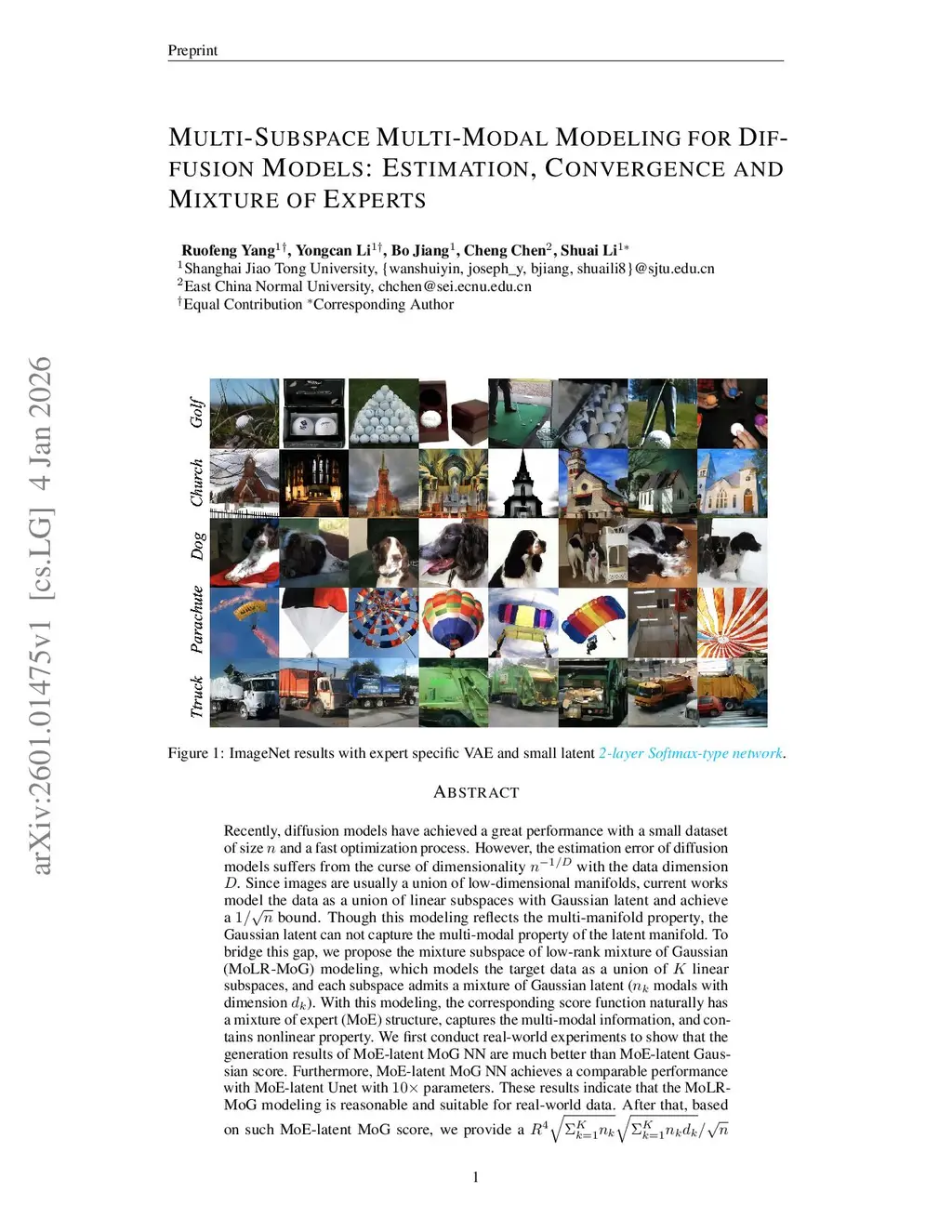
Recently, diffusion models have achieved a great performance with a small dataset of size and a fast optimization process. However, the estimation error of diffusion models suffers from the curse of dimensionality with the data dimension . Since images are usually a union of low-dimensional manifolds, current works model the data as a union of linear subspaces with Gaussian latent and achieve a bound. Though this modeling reflects the multi-manifold property, the Gaussian latent can not capture the multi-modal property of the latent manifold. To bridge this gap, we propose the mixture subspace of low-rank mixture of Gaussian (MoLR-MoG) modeling, which models the target data as a union of linear subspaces, and each subspace admits a mixture of Gaussian latent ( modals with dimension ). With this modeling, the corresponding score function naturally has a mixture of expert (MoE) structure, captures the multi-modal information, and contains nonlinear property. We first conduct real-world experiments to show that the generation results of MoE-latent MoG NN are much better than MoE-latent Gaussian score. Furthermore, MoE-latent MoG NN achieves a comparable performance with MoE-latent Unet with parameters. These results indicate that the MoLR-MoG modeling is reasonable and suitable for real-world data. After that, based on such MoE-latent MoG score, we provide a estimation error, which escapes the curse of dimensionality by using data structure. Finally, we study the optimization process and prove the convergence guarantee under the MoLR-MoG modeling. Combined with these results, under a setting close to real-world data, this work explains why diffusion models only require a small training sample and enjoy a fast optimization process to achieve a great performance.
View on arXiv