
Multi-RADS Synthetic Radiology Report Dataset and Head-to-Head Benchmarking of 41 Open-Weight and Proprietary Language Models
- LM&MA
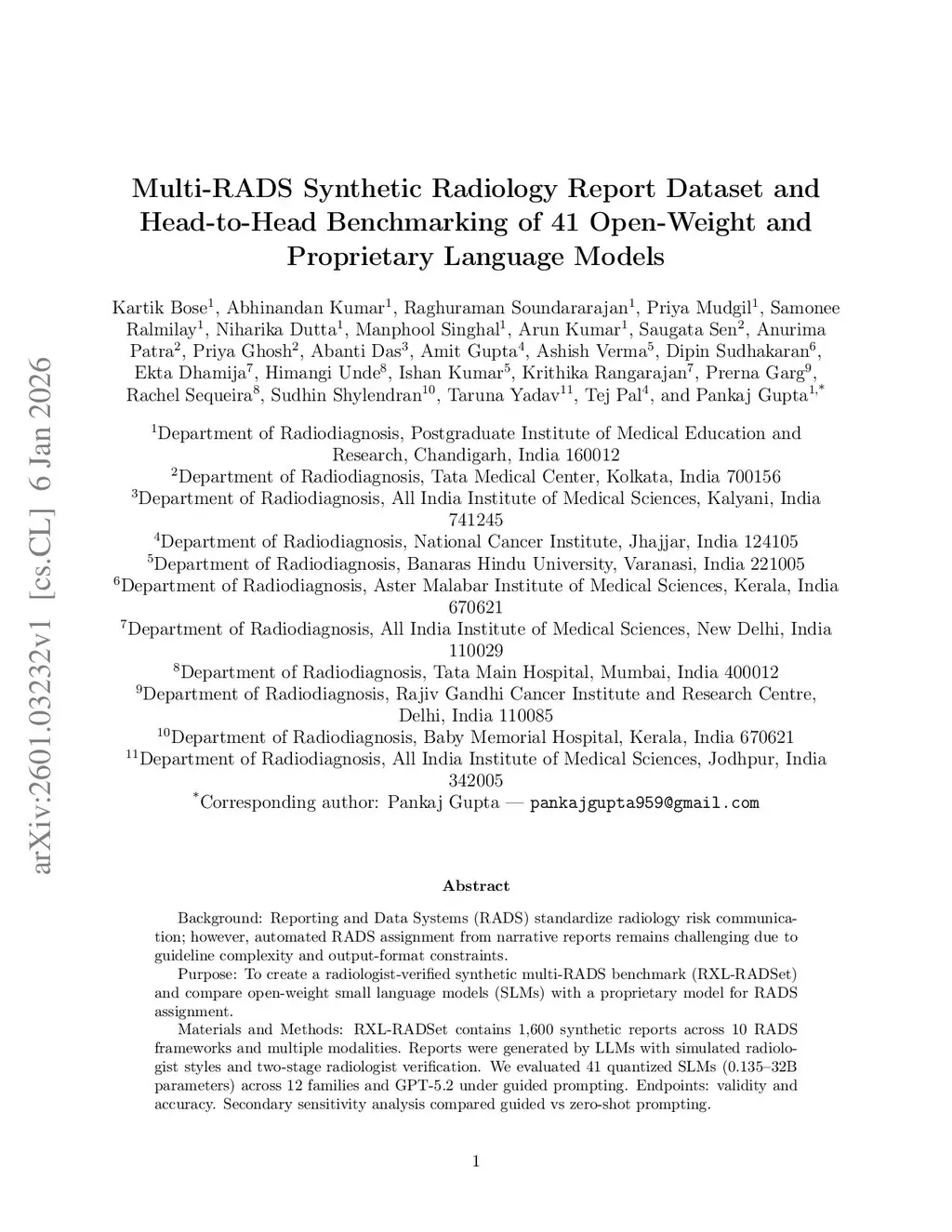
Background: Reporting and Data Systems (RADS) standardize radiology risk communication but automated RADS assignment from narrative reports is challenging because of guideline complexity, output-format constraints, and limited benchmarking across RADS frameworks and model sizes. Purpose: To create RXL-RADSet, a radiologist-verified synthetic multi-RADS benchmark, and compare validity and accuracy of open-weight small language models (SLMs) with a proprietary model for RADS assignment. Materials and Methods: RXL-RADSet contains 1,600 synthetic radiology reports across 10 RADS (BI-RADS, CAD-RADS, GB-RADS, LI-RADS, Lung-RADS, NI-RADS, O-RADS, PI-RADS, TI-RADS, VI-RADS) and multiple modalities. Reports were generated by LLMs using scenario plans and simulated radiologist styles and underwent two-stage radiologist verification. We evaluated 41 quantized SLMs (12 families, 0.135-32B parameters) and GPT-5.2 under a fixed guided prompt. Primary endpoints were validity and accuracy; a secondary analysis compared guided versus zero-shot prompting. Results: Under guided prompting GPT-5.2 achieved 99.8% validity and 81.1% accuracy (1,600 predictions). Pooled SLMs (65,600 predictions) achieved 96.8% validity and 61.1% accuracy; top SLMs in the 20-32B range reached ~99% validity and mid-to-high 70% accuracy. Performance scaled with model size (inflection between <1B and >=10B) and declined with RADS complexity primarily due to classification difficulty rather than invalid outputs. Guided prompting improved validity (99.2% vs 96.7%) and accuracy (78.5% vs 69.6%) compared with zero-shot. Conclusion: RXL-RADSet provides a radiologist-verified multi-RADS benchmark; large SLMs (20-32B) can approach proprietary-model performance under guided prompting, but gaps remain for higher-complexity schemes.
View on arXiv