
WESR: Scaling and Evaluating Word-level Event-Speech Recognition
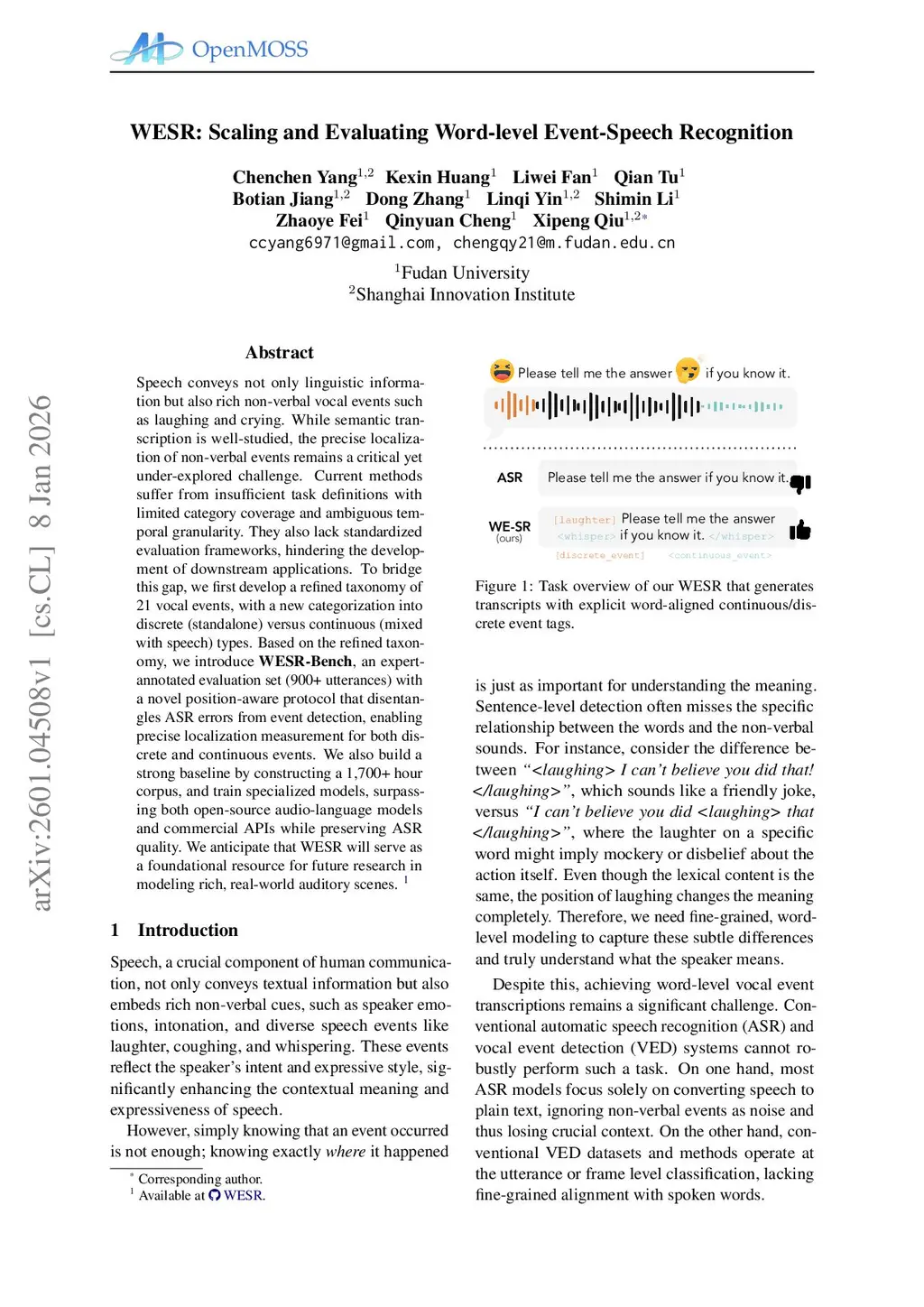
Speech conveys not only linguistic information but also rich non-verbal vocal events such as laughing and crying. While semantic transcription is well-studied, the precise localization of non-verbal events remains a critical yet under-explored challenge. Current methods suffer from insufficient task definitions with limited category coverage and ambiguous temporal granularity. They also lack standardized evaluation frameworks, hindering the development of downstream applications. To bridge this gap, we first develop a refined taxonomy of 21 vocal events, with a new categorization into discrete (standalone) versus continuous (mixed with speech) types. Based on the refined taxonomy, we introduce WESR-Bench, an expert-annotated evaluation set (900+ utterances) with a novel position-aware protocol that disentangles ASR errors from event detection, enabling precise localization measurement for both discrete and continuous events. We also build a strong baseline by constructing a 1,700+ hour corpus, and train specialized models, surpassing both open-source audio-language models and commercial APIs while preserving ASR quality. We anticipate that WESR will serve as a foundational resource for future research in modeling rich, real-world auditory scenes.
View on arXiv