
SemPA: Improving Sentence Embeddings of Large Language Models through Semantic Preference Alignment
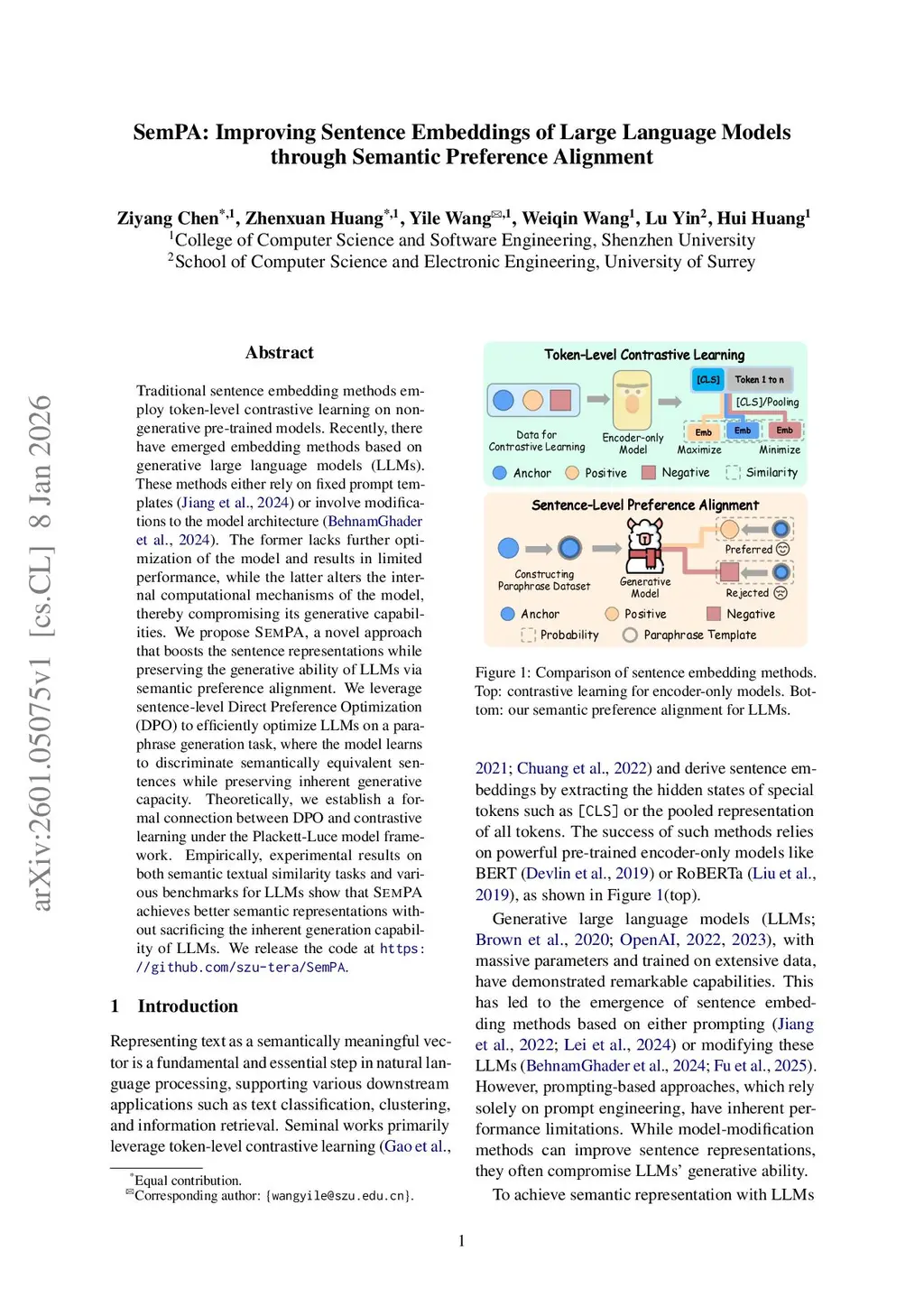
Traditional sentence embedding methods employ token-level contrastive learning on non-generative pre-trained models. Recently, there have emerged embedding methods based on generative large language models (LLMs). These methods either rely on fixed prompt templates or involve modifications to the model architecture. The former lacks further optimization of the model and results in limited performance, while the latter alters the internal computational mechanisms of the model, thereby compromising its generative capabilities. We propose SemPA, a novel approach that boosts the sentence representations while preserving the generative ability of LLMs via semantic preference alignment. We leverage sentence-level Direct Preference Optimization (DPO) to efficiently optimize LLMs on a paraphrase generation task, where the model learns to discriminate semantically equivalent sentences while preserving inherent generative capacity. Theoretically, we establish a formal connection between DPO and contrastive learning under the Plackett-Luce model framework. Empirically, experimental results on both semantic textual similarity tasks and various benchmarks for LLMs show that SemPA achieves better semantic representations without sacrificing the inherent generation capability of LLMs.
View on arXiv