
Autoregressive Ranking: Bridging the Gap Between Dual and Cross Encoders
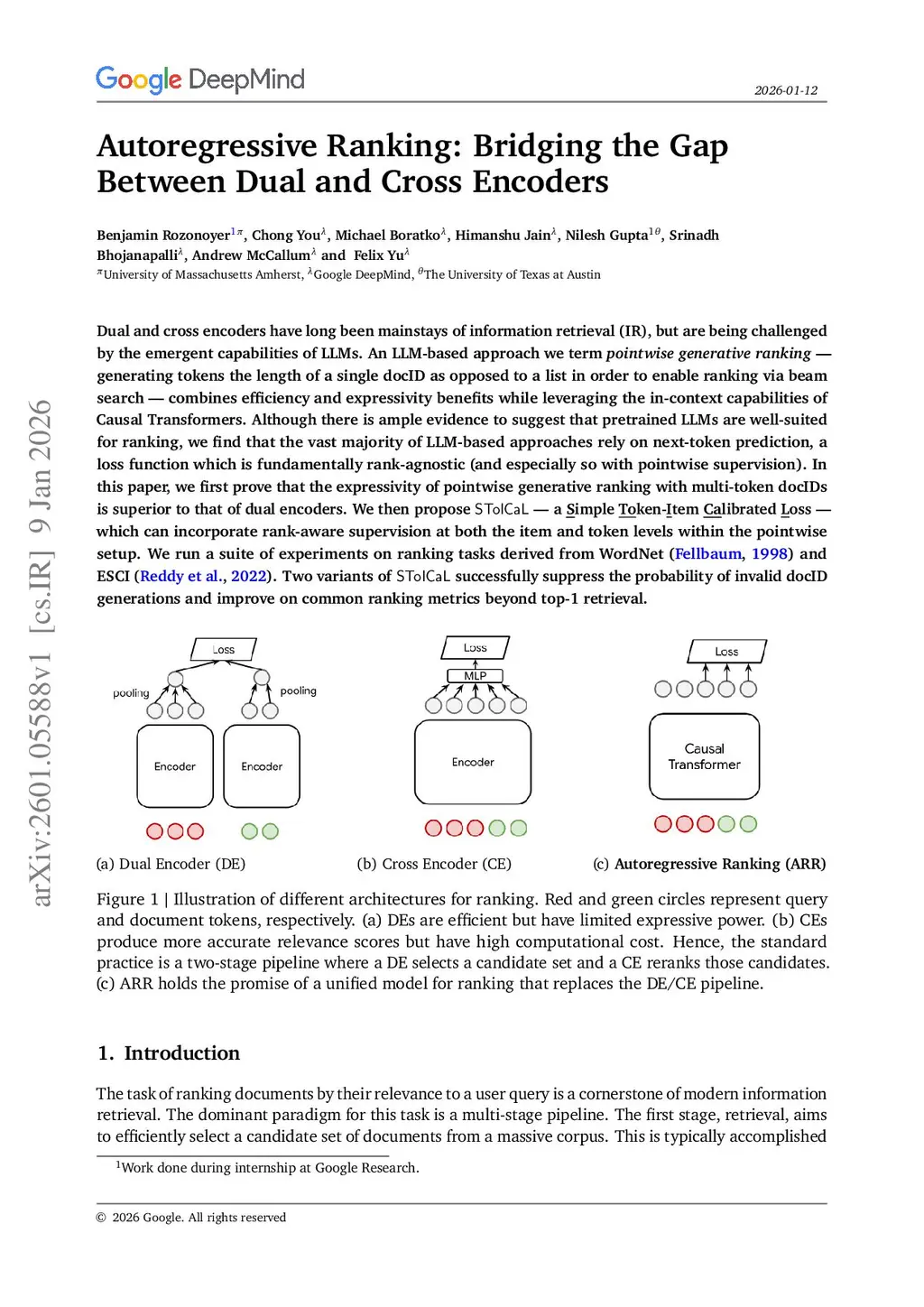
The success of Large Language Models (LLMs) has motivated a shift toward generative approaches to retrieval and ranking, aiming to supersede classical Dual Encoders (DEs) and Cross Encoders (CEs). A prominent paradigm is pointwise Autoregressive Ranking (ARR), where an LLM generates document identifiers (docIDs) token-by-token to enable ranking via beam search. ARR offers the promise of superior expressivity compared to DEs while avoiding the prohibitive computational cost of CEs. However, a formal theoretical foundation for this expressive power has been missing. Moreover, the standard next-token prediction loss is rank-agnostic and inappropriate for finetuning an LLM for ranking tasks.In this paper, we first prove that the expressive capacity of ARR is strictly superior to DEs. While a DE requires an embedding dimension that grows linearly with corpus size to achieve arbitrary rankings, ARR can solve it with a constant hidden dimension. We then propose SToICaL (Simple Token-Item Calibrated Loss), a generalized rank-aware training loss for LLM finetuning. By using item-level reweighting and prefix-tree marginalization, we distribute probability mass over valid docID tokens based on their ground-truth relevance. Experiments on WordNet and ESCI datasets verify that our loss suppresses invalid docID generations and significantly improves ranking metrics beyond top-1 retrieval.
View on arXiv