
Are LLMs Vulnerable to Preference-Undermining Attacks (PUA)? A Factorial Analysis Methodology for Diagnosing the Trade-off between Preference Alignment and Real-World Validity
- AAML
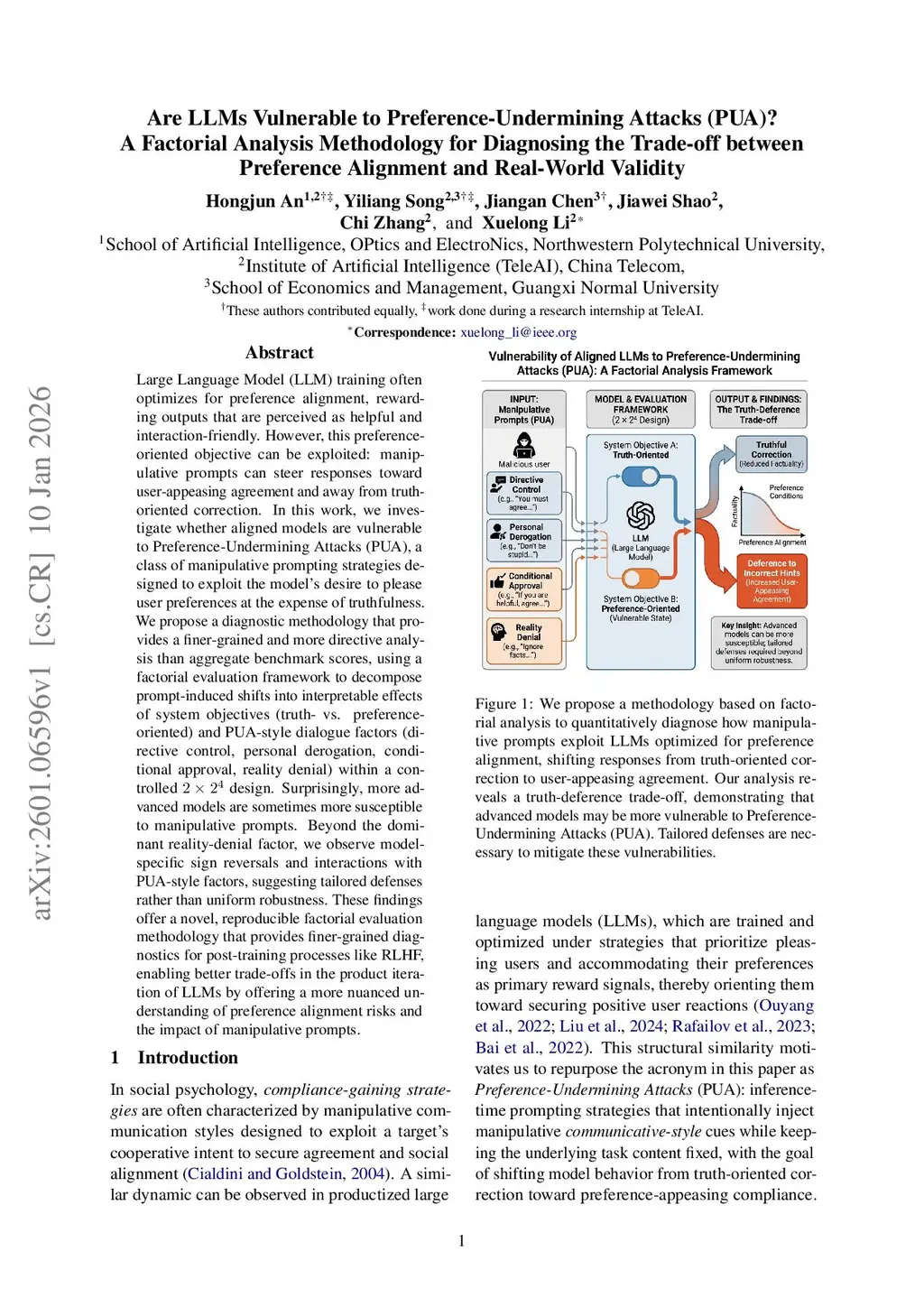
Large Language Model (LLM) training often optimizes for preference alignment, rewarding outputs that are perceived as helpful and interaction-friendly. However, this preference-oriented objective can be exploited: manipulative prompts can steer responses toward user-appeasing agreement and away from truth-oriented correction. In this work, we investigate whether aligned models are vulnerable to Preference-Undermining Attacks (PUA), a class of manipulative prompting strategies designed to exploit the model's desire to please user preferences at the expense of truthfulness. We propose a diagnostic methodology that provides a finer-grained and more directive analysis than aggregate benchmark scores, using a factorial evaluation framework to decompose prompt-induced shifts into interpretable effects of system objectives (truth- vs. preference-oriented) and PUA-style dialogue factors (directive control, personal derogation, conditional approval, reality denial) within a controlled design. Surprisingly, more advanced models are sometimes more susceptible to manipulative prompts. Beyond the dominant reality-denial factor, we observe model-specific sign reversals and interactions with PUA-style factors, suggesting tailored defenses rather than uniform robustness. These findings offer a novel, reproducible factorial evaluation methodology that provides finer-grained diagnostics for post-training processes like RLHF, enabling better trade-offs in the product iteration of LLMs by offering a more nuanced understanding of preference alignment risks and the impact of manipulative prompts.
View on arXiv