
Instruction-Driven 3D Facial Expression Generation and Transition
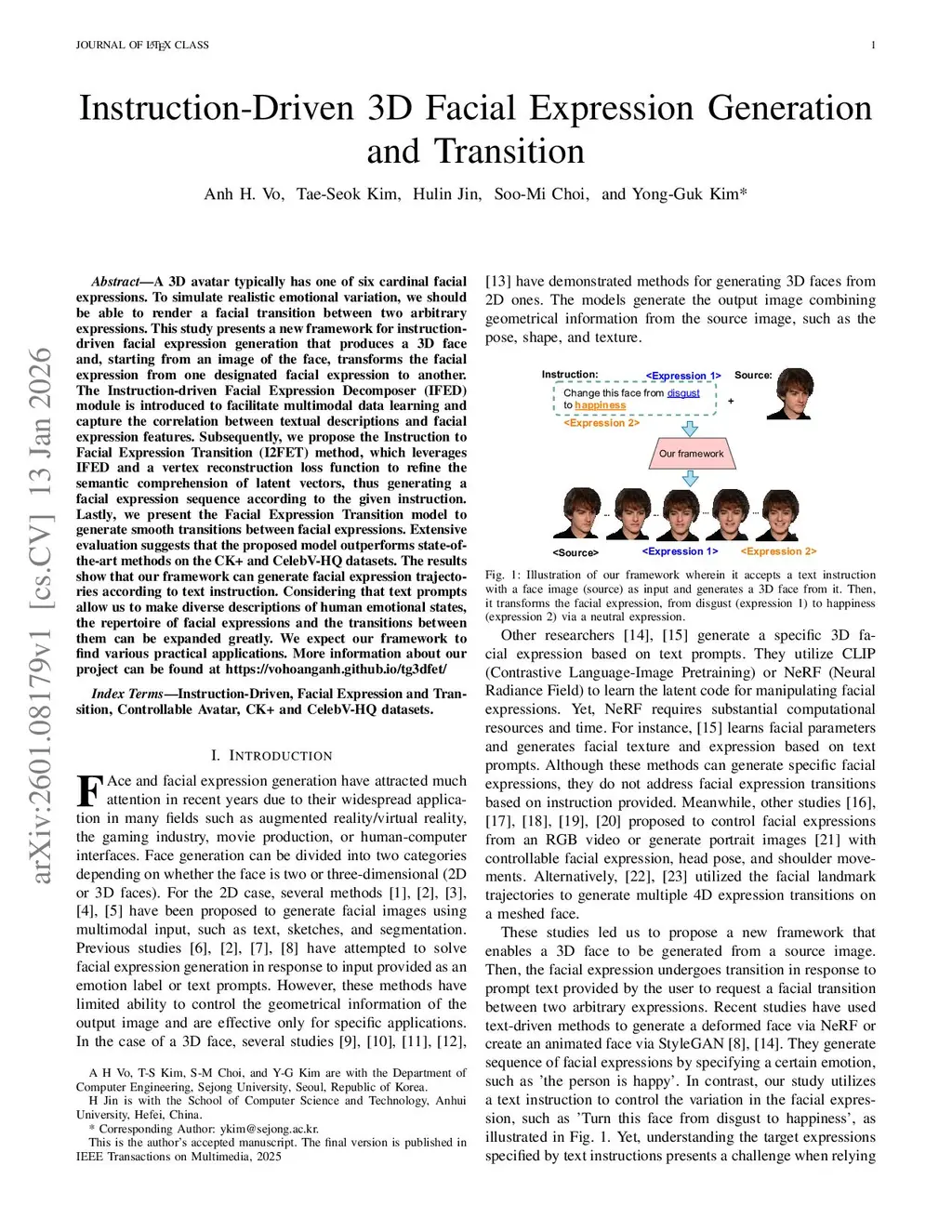
A 3D avatar typically has one of six cardinal facial expressions. To simulate realistic emotional variation, we should be able to render a facial transition between two arbitrary expressions. This study presents a new framework for instruction-driven facial expression generation that produces a 3D face and, starting from an image of the face, transforms the facial expression from one designated facial expression to another. The Instruction-driven Facial Expression Decomposer (IFED) module is introduced to facilitate multimodal data learning and capture the correlation between textual descriptions and facial expression features. Subsequently, we propose the Instruction to Facial Expression Transition (I2FET) method, which leverages IFED and a vertex reconstruction loss function to refine the semantic comprehension of latent vectors, thus generating a facial expression sequence according to the given instruction. Lastly, we present the Facial Expression Transition model to generate smooth transitions between facial expressions. Extensive evaluation suggests that the proposed model outperforms state-of-the-art methods on the CK+ and CelebV-HQ datasets. The results show that our framework can generate facial expression trajectories according to text instruction. Considering that text prompts allow us to make diverse descriptions of human emotional states, the repertoire of facial expressions and the transitions between them can be expanded greatly. We expect our framework to find various practical applications More information about our project can be found atthis https URL
View on arXiv