
PI-Light: Physics-Inspired Diffusion for Full-Image Relighting
- AI4CE
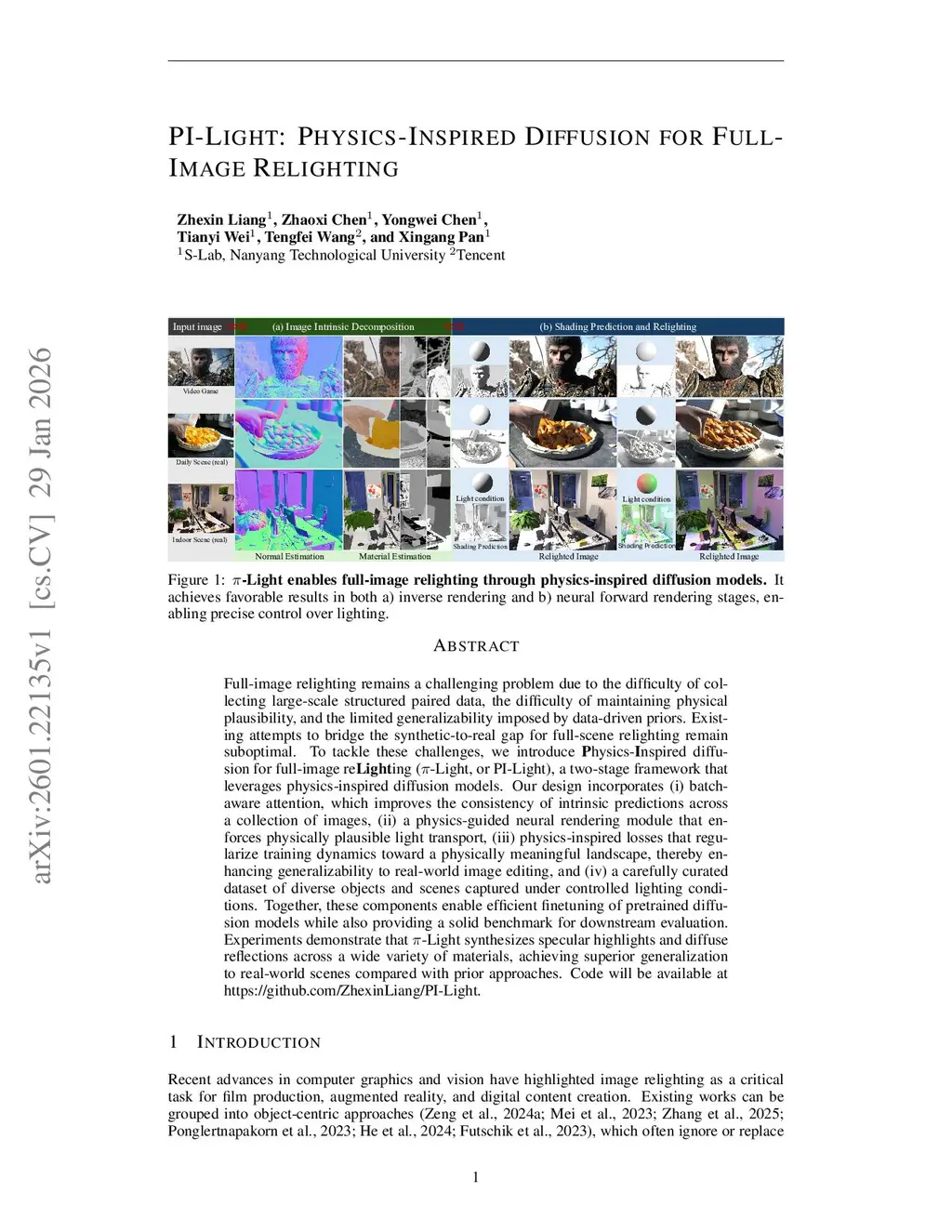
Full-image relighting remains a challenging problem due to the difficulty of collecting large-scale structured paired data, the difficulty of maintaining physical plausibility, and the limited generalizability imposed by data-driven priors. Existing attempts to bridge the synthetic-to-real gap for full-scene relighting remain suboptimal. To tackle these challenges, we introduce Physics-Inspired diffusion for full-image reLight (-Light, or PI-Light), a two-stage framework that leverages physics-inspired diffusion models. Our design incorporates (i) batch-aware attention, which improves the consistency of intrinsic predictions across a collection of images, (ii) a physics-guided neural rendering module that enforces physically plausible light transport, (iii) physics-inspired losses that regularize training dynamics toward a physically meaningful landscape, thereby enhancing generalizability to real-world image editing, and (iv) a carefully curated dataset of diverse objects and scenes captured under controlled lighting conditions. Together, these components enable efficient finetuning of pretrained diffusion models while also providing a solid benchmark for downstream evaluation. Experiments demonstrate that -Light synthesizes specular highlights and diffuse reflections across a wide variety of materials, achieving superior generalization to real-world scenes compared with prior approaches.
View on arXiv