
Game-Based and Gamified Robotics Education: A Comparative Systematic Review and Design Guidelines
- AI4CE
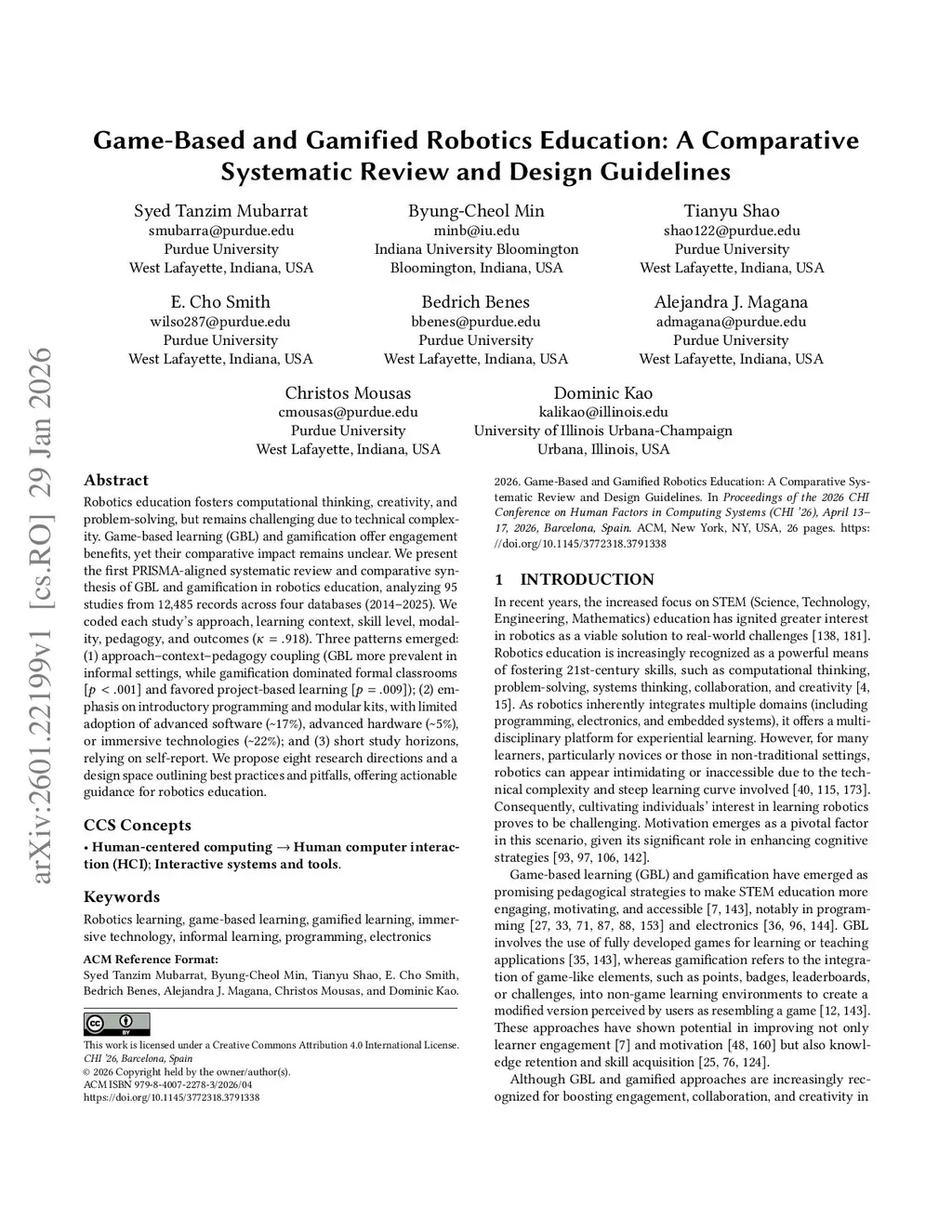
Robotics education fosters computational thinking, creativity, and problem-solving, but remains challenging due to technical complexity. Game-based learning (GBL) and gamification offer engagement benefits, yet their comparative impact remains unclear. We present the first PRISMA-aligned systematic review and comparative synthesis of GBL and gamification in robotics education, analyzing 95 studies from 12,485 records across four databases (2014-2025). We coded each study's approach, learning context, skill level, modality, pedagogy, and outcomes (k = .918). Three patterns emerged: (1) approach-context-pedagogy coupling (GBL more prevalent in informal settings, while gamification dominated formal classrooms [p < .001] and favored project-based learning [p = .009]); (2) emphasis on introductory programming and modular kits, with limited adoption of advanced software (~17%), advanced hardware (~5%), or immersive technologies (~22%); and (3) short study horizons, relying on self-report. We propose eight research directions and a design space outlining best practices and pitfalls, offering actionable guidance for robotics education.
View on arXiv