
Causal Characterization of Measurement and Mechanistic Anomalies
- CML
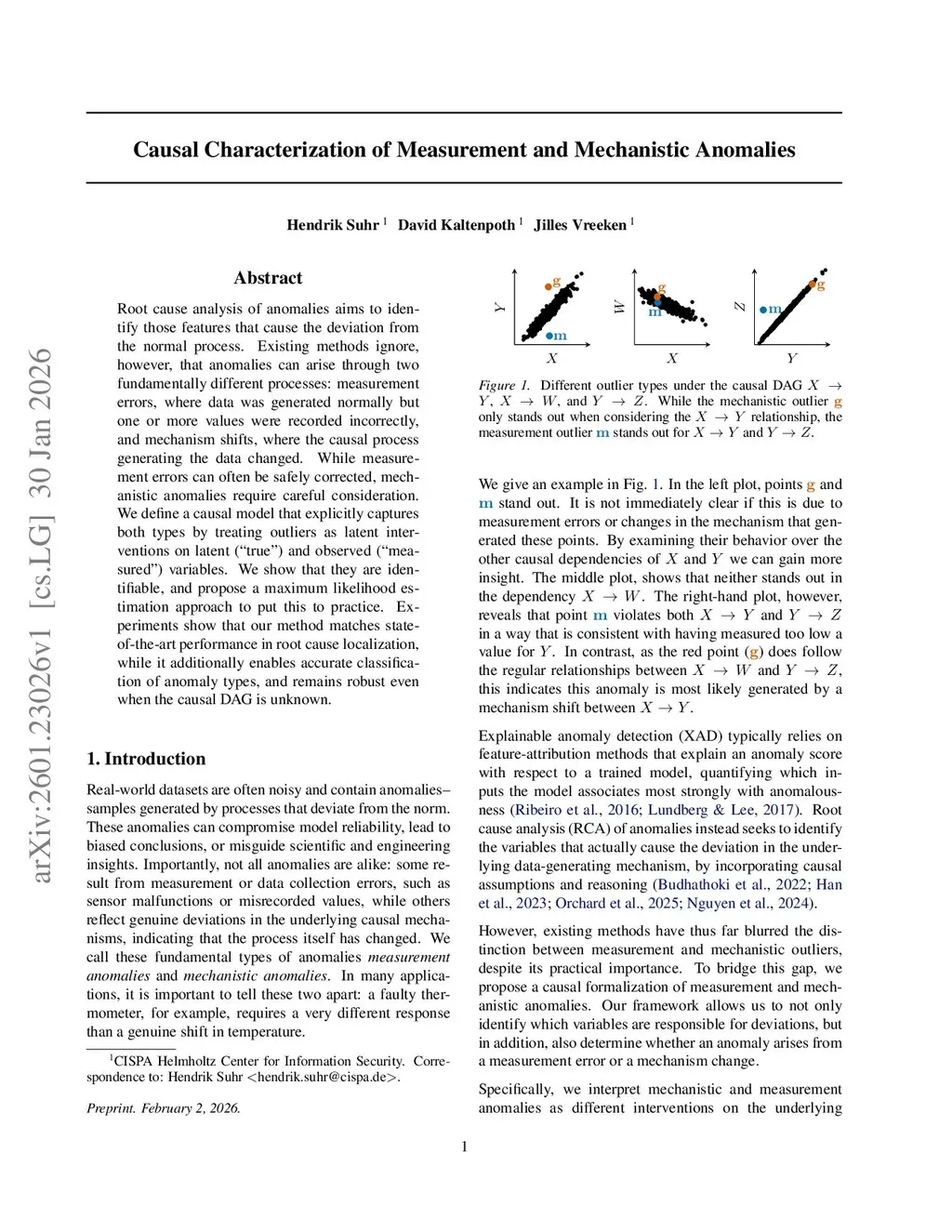
Root cause analysis of anomalies aims to identify those features that cause the deviation from the normal process. Existing methods ignore, however, that anomalies can arise through two fundamentally different processes: measurement errors, where data was generated normally but one or more values were recorded incorrectly, and mechanism shifts, where the causal process generating the data changed. While measurement errors can often be safely corrected, mechanistic anomalies require careful consideration. We define a causal model that explicitly captures both types by treating outliers as latent interventions on latent ("true") and observed ("measured") variables. We show that they are identifiable, and propose a maximum likelihood estimation approach to put this to practice. Experiments show that our method matches state-of-the-art performance in root cause localization, while it additionally enables accurate classification of anomaly types, and remains robust even when the causal DAG is unknown.
View on arXiv