
When RAG Hurts: Diagnosing and Mitigating Attention Distraction in Retrieval-Augmented LVLMs
- VLM
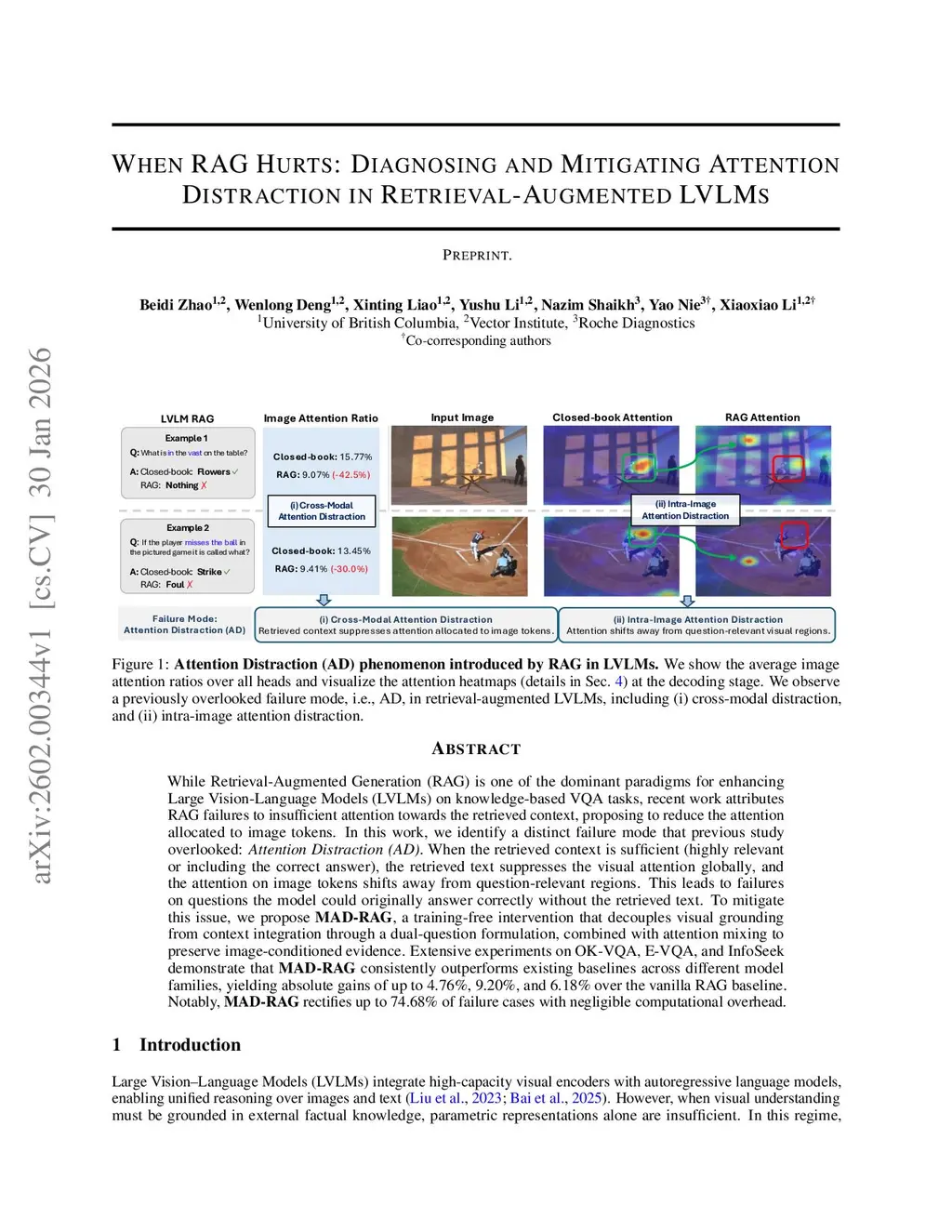
While Retrieval-Augmented Generation (RAG) is one of the dominant paradigms for enhancing Large Vision-Language Models (LVLMs) on knowledge-based VQA tasks, recent work attributes RAG failures to insufficient attention towards the retrieved context, proposing to reduce the attention allocated to image tokens. In this work, we identify a distinct failure mode that previous study overlooked: Attention Distraction (AD). When the retrieved context is sufficient (highly relevant or including the correct answer), the retrieved text suppresses the visual attention globally, and the attention on image tokens shifts away from question-relevant regions. This leads to failures on questions the model could originally answer correctly without the retrieved text. To mitigate this issue, we propose MAD-RAG, a training-free intervention that decouples visual grounding from context integration through a dual-question formulation, combined with attention mixing to preserve image-conditioned evidence. Extensive experiments on OK-VQA, E-VQA, and InfoSeek demonstrate that MAD-RAG consistently outperforms existing baselines across different model families, yielding absolute gains of up to 4.76%, 9.20%, and 6.18% over the vanilla RAG baseline. Notably, MAD-RAG rectifies up to 74.68% of failure cases with negligible computational overhead.
View on arXiv