
Adaptive Dual-Weighting Framework for Federated Learning via Out-of-Distribution Detection
- FedMLOODD
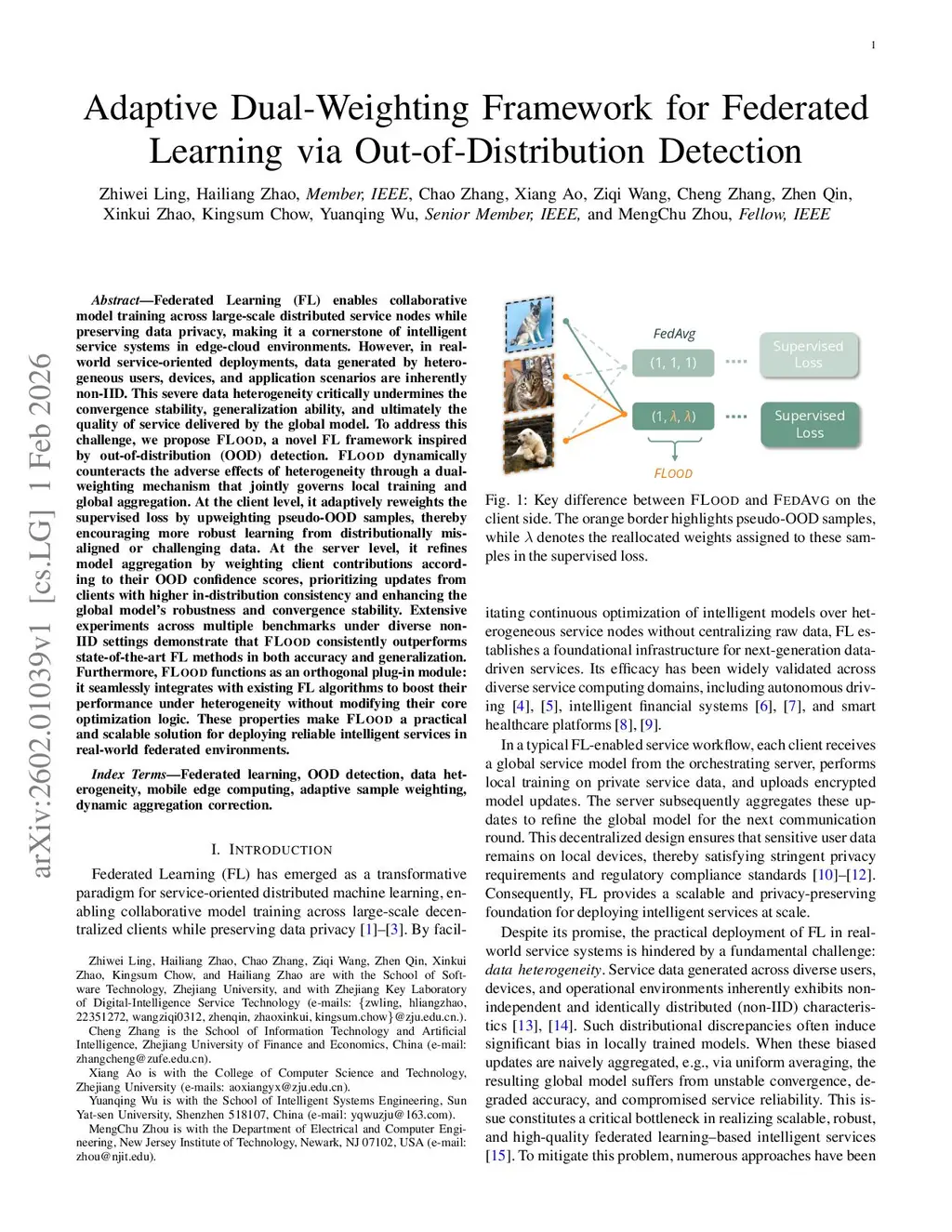
Federated Learning (FL) enables collaborative model training across large-scale distributed service nodes while preserving data privacy, making it a cornerstone of intelligent service systems in edge-cloud environments. However, in real-world service-oriented deployments, data generated by heterogeneous users, devices, and application scenarios are inherently non-IID. This severe data heterogeneity critically undermines the convergence stability, generalization ability, and ultimately the quality of service delivered by the global model. To address this challenge, we propose FLood, a novel FL framework inspired by out-of-distribution (OOD) detection. FLood dynamically counteracts the adverse effects of heterogeneity through a dual-weighting mechanism that jointly governs local training and global aggregation. At the client level, it adaptively reweights the supervised loss by upweighting pseudo-OOD samples, thereby encouraging more robust learning from distributionally misaligned or challenging data. At the server level, it refines model aggregation by weighting client contributions according to their OOD confidence scores, prioritizing updates from clients with higher in-distribution consistency and enhancing the global model's robustness and convergence stability. Extensive experiments across multiple benchmarks under diverse non-IID settings demonstrate that FLood consistently outperforms state-of-the-art FL methods in both accuracy and generalization. Furthermore, FLood functions as an orthogonal plug-in module: it seamlessly integrates with existing FL algorithms to boost their performance under heterogeneity without modifying their core optimization logic. These properties make FLood a practical and scalable solution for deploying reliable intelligent services in real-world federated environments.
View on arXiv