
Path Tracking with Dynamic Control Point Blending for Autonomous Vehicles: An Experimental Study
- LLMSV
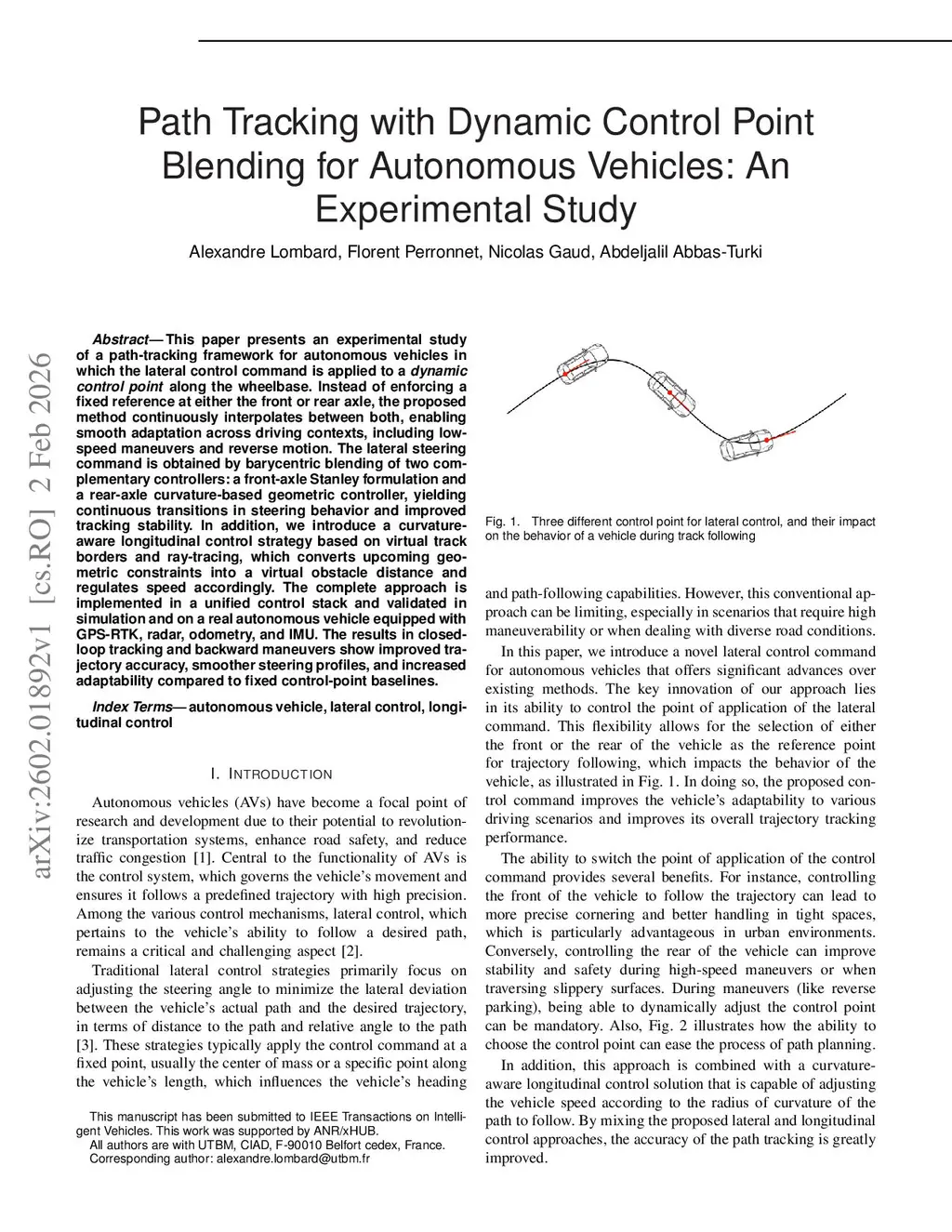
This paper presents an experimental study of a path-tracking framework for autonomous vehicles in which the lateral control command is applied to a dynamic control point along the wheelbase. Instead of enforcing a fixed reference at either the front or rear axle, the proposed method continuously interpolates between both, enabling smooth adaptation across driving contexts, including low-speed maneuvers and reverse motion. The lateral steering command is obtained by barycentric blending of two complementary controllers: a front-axle Stanley formulation and a rear-axle curvature-based geometric controller, yielding continuous transitions in steering behavior and improved tracking stability. In addition, we introduce a curvature-aware longitudinal control strategy based on virtual track borders and ray-tracing, which converts upcoming geometric constraints into a virtual obstacle distance and regulates speed accordingly. The complete approach is implemented in a unified control stack and validated in simulation and on a real autonomous vehicle equipped with GPS-RTK, radar, odometry, and IMU. The results in closed-loop tracking and backward maneuvers show improved trajectory accuracy, smoother steering profiles, and increased adaptability compared to fixed control-point baselines.
View on arXiv