
Show, Don't Tell: Morphing Latent Reasoning into Image Generation
- ReLMLRM
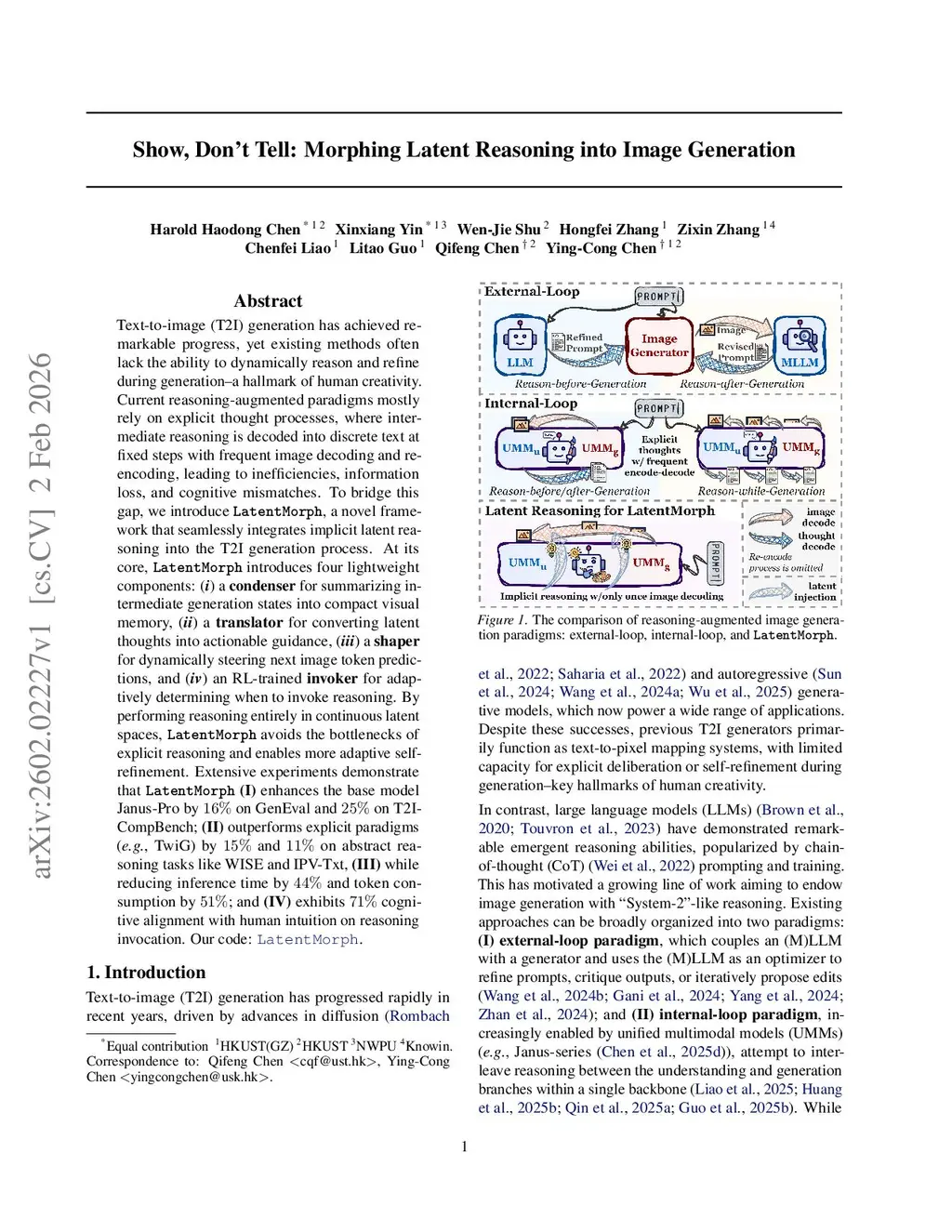
Text-to-image (T2I) generation has achieved remarkable progress, yet existing methods often lack the ability to dynamically reason and refine during generation--a hallmark of human creativity. Current reasoning-augmented paradigms most rely on explicit thought processes, where intermediate reasoning is decoded into discrete text at fixed steps with frequent image decoding and re-encoding, leading to inefficiencies, information loss, and cognitive mismatches. To bridge this gap, we introduce LatentMorph, a novel framework that seamlessly integrates implicit latent reasoning into the T2I generation process. At its core, LatentMorph introduces four lightweight components: (i) a condenser for summarizing intermediate generation states into compact visual memory, (ii) a translator for converting latent thoughts into actionable guidance, (iii) a shaper for dynamically steering next image token predictions, and (iv) an RL-trained invoker for adaptively determining when to invoke reasoning. By performing reasoning entirely in continuous latent spaces, LatentMorph avoids the bottlenecks of explicit reasoning and enables more adaptive self-refinement. Extensive experiments demonstrate that LatentMorph (I) enhances the base model Janus-Pro by on GenEval and on T2I-CompBench; (II) outperforms explicit paradigms (e.g., TwiG) by and on abstract reasoning tasks like WISE and IPV-Txt, (III) while reducing inference time by and token consumption by ; and (IV) exhibits cognitive alignment with human intuition on reasoning invocation.
View on arXiv