
LEVIO: Lightweight Embedded Visual Inertial Odometry for Resource-Constrained Devices
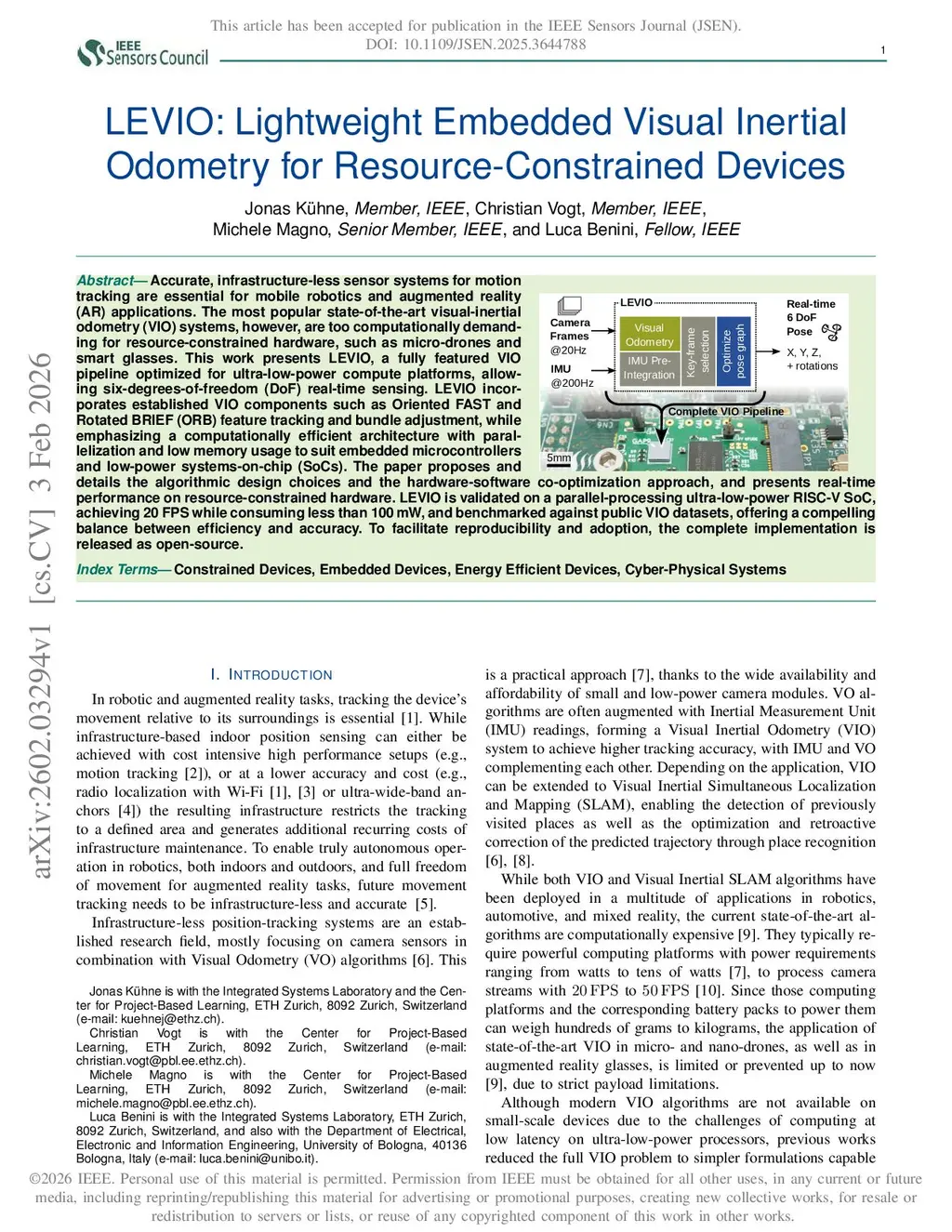
Accurate, infrastructure-less sensor systems for motion tracking are essential for mobile robotics and augmented reality (AR) applications. The most popular state-of-the-art visual-inertial odometry (VIO) systems, however, are too computationally demanding for resource-constrained hardware, such as micro-drones and smart glasses. This work presents LEVIO, a fully featured VIO pipeline optimized for ultra-low-power compute platforms, allowing six-degrees-of-freedom (DoF) real-time sensing. LEVIO incorporates established VIO components such as Oriented FAST and Rotated BRIEF (ORB) feature tracking and bundle adjustment, while emphasizing a computationally efficient architecture with parallelization and low memory usage to suit embedded microcontrollers and low-power systems-on-chip (SoCs). The paper proposes and details the algorithmic design choices and the hardware-software co-optimization approach, and presents real-time performance on resource-constrained hardware. LEVIO is validated on a parallel-processing ultra-low-power RISC-V SoC, achieving 20 FPS while consuming less than 100 mW, and benchmarked against public VIO datasets, offering a compelling balance between efficiency and accuracy. To facilitate reproducibility and adoption, the complete implementation is released as open-source.
View on arXiv