
VTok: A Unified Video Tokenizer with Decoupled Spatial-Temporal Latents
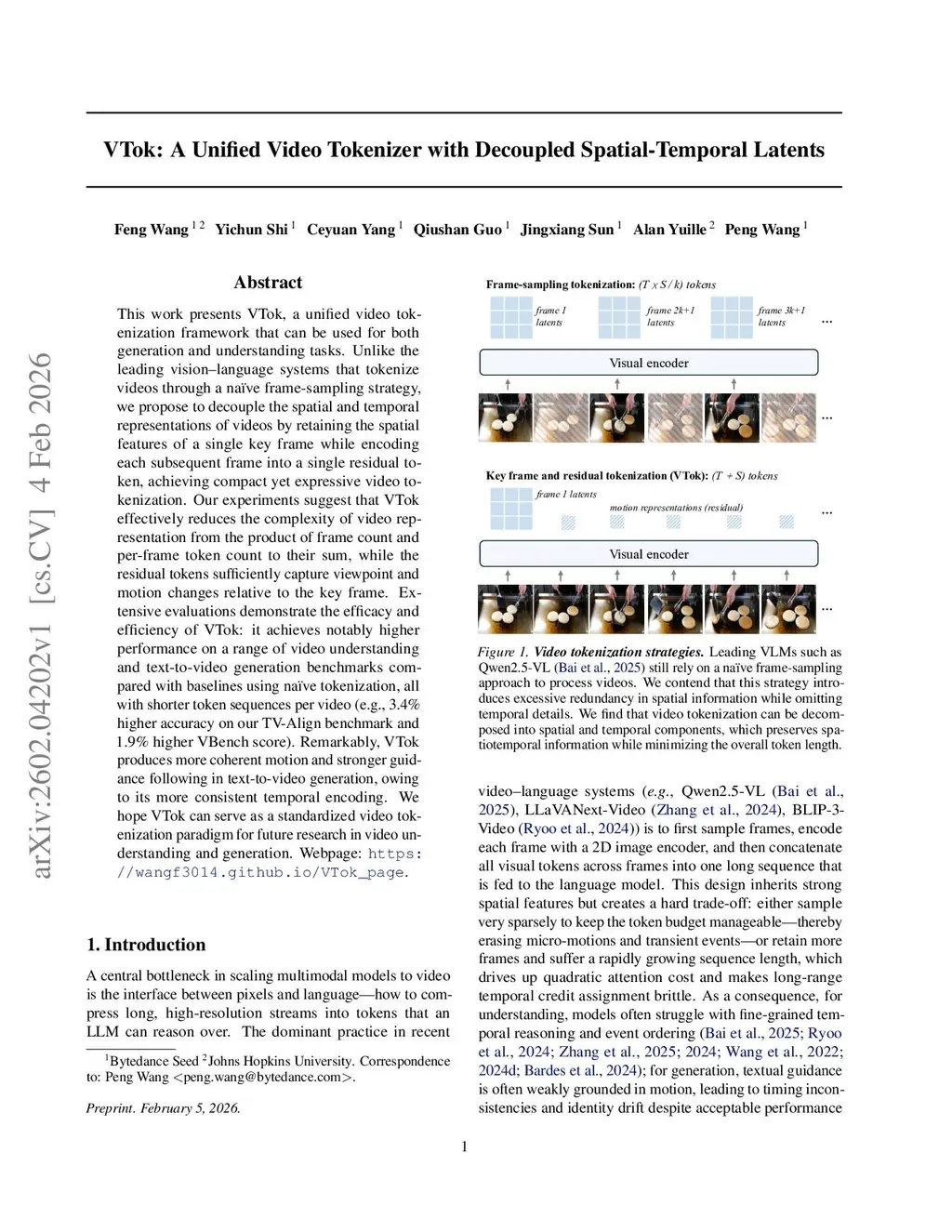
This work presents VTok, a unified video tokenization framework that can be used for both generation and understanding tasks. Unlike the leading vision-language systems that tokenize videos through a naive frame-sampling strategy, we propose to decouple the spatial and temporal representations of videos by retaining the spatial features of a single key frame while encoding each subsequent frame into a single residual token, achieving compact yet expressive video tokenization. Our experiments suggest that VTok effectively reduces the complexity of video representation from the product of frame count and per-frame token count to their sum, while the residual tokens sufficiently capture viewpoint and motion changes relative to the key frame. Extensive evaluations demonstrate the efficacy and efficiency of VTok: it achieves notably higher performance on a range of video understanding and text-to-video generation benchmarks compared with baselines using naive tokenization, all with shorter token sequences per video (e.g., 3.4% higher accuracy on our TV-Align benchmark and 1.9% higher VBench score). Remarkably, VTok produces more coherent motion and stronger guidance following in text-to-video generation, owing to its more consistent temporal encoding. We hope VTok can serve as a standardized video tokenization paradigm for future research in video understanding and generation.
View on arXiv